How to Make a Chess Variant
Chess variants are easy to dream up and hard to balance. Here is how to describe new pieces precisely, get move validation right and find out if your variant is fair.
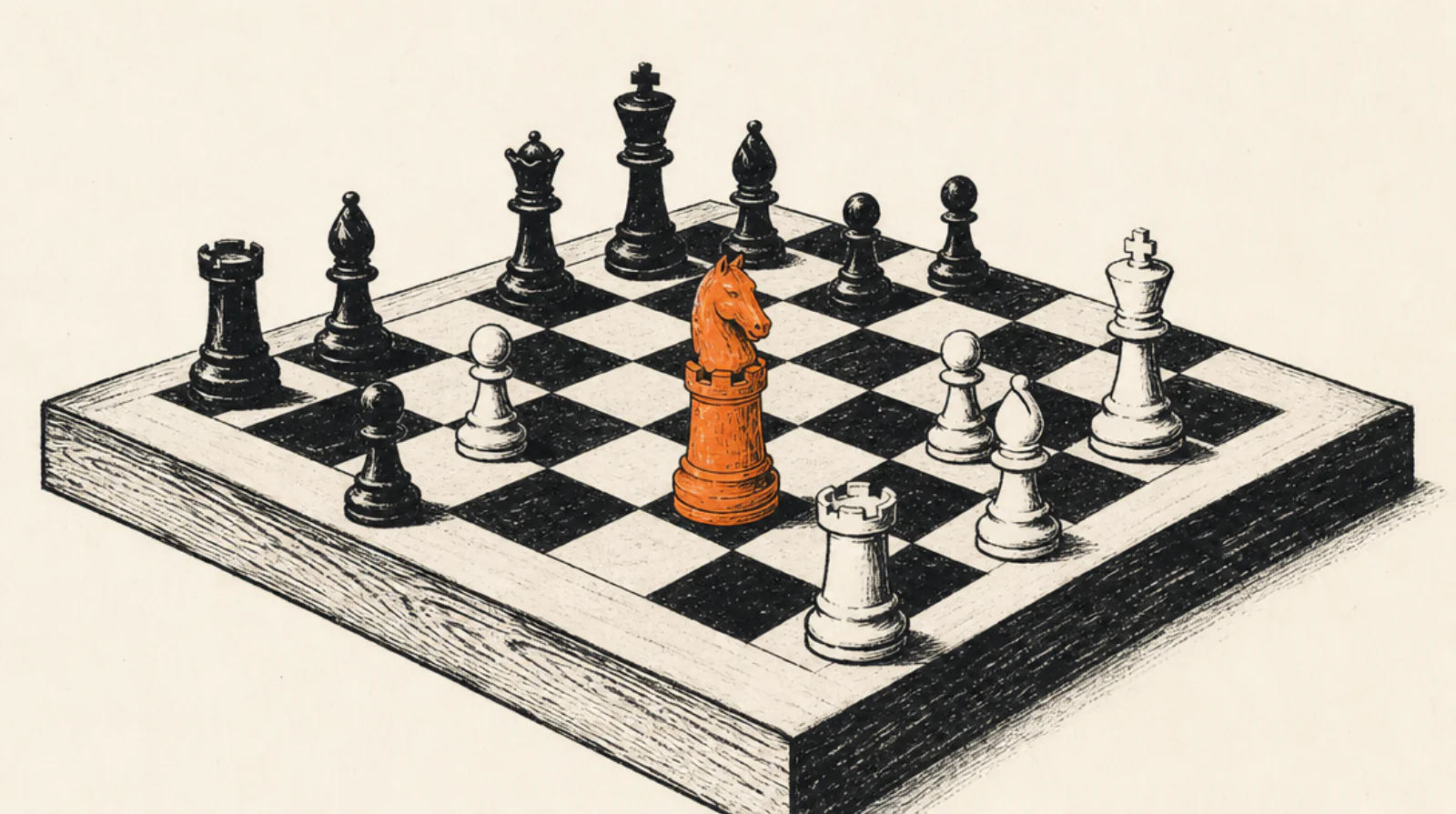
Key takeaways
- Describe every piece as a combination of moves: steps, leaps and slides in given directions, plus how it captures.
- Validate moves in two passes: generate the piece's moves, then remove any that leave your own king in check.
- Decide the special rules (castling, en passant, promotion) for your variant explicitly. They are where bugs hide.
- A small computer opponent that plays itself hundreds of times gives you a first read on balance.
To make a chess variant, change one thing about chess on purpose (a new piece, a different board, a twist on winning), write each piece's movement as precise rules, build move validation that includes check, then playtest heavily, ideally with a simple computer opponent playing itself to spot imbalance. The good news: chess is fully specified, so the base engine is well understood. The work is in your changes, and in being exact about them.
Change one thing first
The variants that last tend to change one idea. Chess960 shuffles the back row so opening memorization stops mattering. Capablanca chess adds two compound pieces on a wider board. Atomic chess makes captures explode. Three-check wins on the third check. Pick your one idea and keep everything else standard until it plays well. Common directions:
- New pieces: a piece that moves like a rook or a knight, a piece that jumps two squares, a piece that cannot capture but blocks.
- New board: 10 by 8, 6 by 6 for faster games, or holes in the board.
- New win condition: reach the far rank with the king, capture all pawns, or a number of checks.
- New rule: pieces you capture join your side, a fog of war where you only see squares your pieces attack, or two moves per turn.
Describe pieces precisely
Fairy chess, the tradition of invented chess pieces, describes every piece with a few building blocks. Use them in your brief and nothing will be ambiguous:
- Step: moves exactly one square in given directions (the king steps in all eight).
- Leap: jumps to squares at a fixed offset, ignoring pieces in between (the knight leaps 1 by 2).
- Slide (or ride): moves any number of squares in a direction until blocked (rook orthogonally, bishop diagonally).
- Compound: combines two of these (the queen is rook plus bishop; Capablanca's chancellor is rook plus knight; its archbishop is bishop plus knight).
- Capture rules: most pieces capture the way they move. Some do not: the pawn moves forward but captures diagonally. Say it explicitly for each new piece.
- Restrictions: cannot cross the middle, only moves forward, cannot capture certain pieces, and so on.
For example: "The Ferryman slides up to 3 squares diagonally, cannot jump, captures the same way, and cannot be captured by pawns." That sentence is a complete specification. "The Ferryman is like a weaker bishop" is not.
Move validation in two passes
The standard approach used by chess programs works for variants too:
- 01Generate pseudo-legal moves: for each piece, list every square it could reach by its movement rules on the current board, respecting blocking and capture rules.
- 02Filter for check: for each of those moves, apply it on a copy of the board, then ask whether the moving side's king is attacked. If it is, the move is illegal.
- 03End states: if the side to move has no legal moves, it is checkmate when their king is attacked and stalemate when it is not.
With new pieces, "is the king attacked?" means checking every enemy piece's attacks, including the new ones. This is the most common bug in variants: a new piece that gives check but the engine does not notice, or a king allowed to step next to a piece whose capture rule differs from its movement.
Decide the special rules out loud
Standard chess has three special rules that are easy to forget and easy to get wrong. Decide each one for your variant:
- Castling: does it exist? On a wider board, how far does the king move? Can the king castle out of or through check (in standard chess, no)?
- En passant: keep, drop, or extend to new pawn-like pieces?
- Promotion: which pieces can a pawn become, including your new ones?
- Draw rules: threefold repetition and the fifty-move rule. Many casual variants skip them, but endless games need some cut-off.
A computer opponent and self-play
A simple computer opponent is valuable for two reasons: people can play alone, and you can measure balance. The classic technique is minimax search with alpha-beta pruning: look a few moves ahead and pick the move that leads to the best position, scored by material (piece values) plus small bonuses for mobility and center control. In a browser, a search of three or four moves ahead is responsive enough for casual play. The enemy AI guide covers making a computer opponent beatable on purpose.
For new pieces you need a value. Standard values are roughly pawn 1, knight 3, bishop 3, rook 5, queen 9. Estimate new pieces by how many squares they control on an open board compared to those, then adjust after play. Then run self-play: let the computer play itself a few hundred games and count white wins, black wins and draws. If one side wins far more than in regular chess, or games always end the same way, something is off. It is not a substitute for human testing, but it finds broken pieces fast.
A chess variant brief to paste
A chess variant called Ferry Chess, playable in the browser. Board 8x8. Standard pieces and rules (castling, en passant, promotion, threefold repetition, 50-move rule) except: each side replaces one bishop with a Ferryman, which slides up to 3 squares diagonally, cannot jump, captures the same way, and cannot be captured by pawns. Pawns can promote to a Ferryman. Move validation in two passes: generate moves, then remove moves that leave your own king in check; detect checkmate and stalemate. Highlight legal moves when a piece is picked, show the last move and check. Modes: play a friend on the same device, play the computer (minimax with alpha-beta, depth 3, values pawn 1, knight 3, bishop 3, Ferryman 2.5, rook 5, queen 9), and an online room by link for two players. Include position-based tests for every piece, and a self-play script that runs 200 computer games and reports win and draw rates. Clean wooden board look, works on phones.
Online play between two people is turn-based, which makes it one of the easiest kinds of multiplayer: a move every few seconds or minutes, and order never in doubt. It fits a room server (previews run it on every plan, publishing it with the game is on paid plans) or saved games in a database for correspondence play. See how to turn a board game into an online game for async play with notifications.
Playtesting for balance
- Play the openings. New pieces often create a forced early win nobody spotted. Play ten games focusing only on the first ten moves.
- Watch for dominant pieces. If the new piece is always traded first or always decides the game, its value is off.
- Check endgames. Can a king and your new piece force checkmate against a lone king? If not, games may end in draws you did not intend.
- Invite strong players. Experienced chess players find exploits quickly. Share a preview link and ask them to break it.
- Change one number at a time. Range 3 to range 2, then test again.
When it holds up, publish it to a link and share it with the people you play with. If you want to try a variant fast without designing it all, the brief above is a complete starting point. Save a checkpoint before each rule change so you can compare versions side by side. When friends start asking for it, how to get players for your game covers the next step.
Frequently asked questions
How do I invent a new chess piece?
Combine steps, leaps and slides in specific directions, define how it captures and any restrictions, and estimate its value by how many squares it controls compared to standard pieces. Then playtest.
How does a chess game check if a move is legal?
It lists every move a piece could make by its movement rules, then plays each on a copy of the board and removes those that leave the mover's own king in check.
How do I know if my chess variant is balanced?
Play many games, watch for forced openings and pieces that always decide the game, and use computer self-play to compare white and black win rates against regular chess.
Can people play my chess variant online against each other?
Yes. Chess is turn-based, which is one of the easiest kinds of online play to build, either live in a room or as saved correspondence games.

