How to make a game like Slay the Spire
The roguelike deckbuilder is a strategy game where your deck is the character sheet. Three systems carry it: visible intents, a branching map and the card reward choice.
Key takeaways
- Show what each enemy will do next turn. Visible intent turns combat from guessing into planning.
- Card rewards are a pick of one from three, and skipping is allowed. Deck quality matters more than deck size.
- A branching map lets the player choose risk. Its name, characters, cards, relics, art and exact rules belong to its owner.
Building a game like Slay the Spire means building a roguelike deckbuilder: the player starts each run with a small, weak deck, fights turn-based battles by playing cards with a limited energy budget, sees exactly what each enemy intends to do next turn, and after each fight adds one card from a choice of three. A branching map lets them pick their path through fights, shops, rest sites and elites toward a boss. Lose and you start again with new choices; the knowledge stays with you.
Slay the Spire, its characters, its cards and relics, its art and its exact rules belong to its developer. The roguelike deckbuilder is a whole genre now, and the systems below are shared design vocabulary. Your game needs its own theme, cards, enemies and a mechanical idea of its own.
Why roguelike deckbuilders hook people
- Every turn is a puzzle with full information. You see your hand, your energy and the enemy's intent. Bad turns are your fault, which makes good turns yours too.
- The deck is the build. Each card you add or remove changes the odds of every future hand. Players learn to say no to cards.
- Runs tell stories. A rare card in floor two can steer a whole run toward a strategy.
- Short to start, deep to master. A run is 30 to 60 minutes, and players replay for years.
The combat turn
At the start of each player turn: draw five cards, refill energy to three. Cards cost 0 to 3 energy. Unplayed cards go to the discard pile at turn end, and when the draw pile is empty the discard pile is shuffled back in. Block (a shield value) resets each turn unless a card says otherwise. Then enemies act in order.
- Starting deck: about ten cards, mostly basic attack and basic defend, plus one signature card.
- Starting health: around 70 to 80, healed only at rest sites and by some rewards, so damage carries across fights.
- Card data: `{ id, name, cost, type, rarity, target, effects[], upgraded }`, where `effects` is a list like `[{ kind: "damage", amount: 6 }, { kind: "applyStatus", status: "weak", turns: 1 }]`. Write effects as data and you can build hundreds of cards from a dozen effect kinds.
- Statuses: a small set that stacks or counts down (weaken, vulnerable, poison, strength). Four to six is plenty for a first version.
The turn-based combat system article walks through the turn state machine; the deckbuilder guide covers draw, discard and exhaust piles in more detail.
Visible intents: the key idea
Above each enemy, show an icon and a number for its next action: attack for 12, block, buff, debuff, or something unknown. This is what makes the genre strategic. The player can go all-in on damage when the enemy is about to block, or stack defense against a big hit.
- Enemy AI is a pattern, not a brain. Each enemy has a move list with weights and rules ("never use the big attack twice in a row", "buff every third turn"). Pick the next move at the end of its turn and show it immediately.
- Make intents honest. If an enemy shows 12 damage, it deals 12 after modifiers. Hidden surprises break trust.
- Elites and bosses get scripted openers and a phase change at half health.
Rewards and deck thinning
After each normal fight, offer three cards and a Skip. Rarity odds might start at 60 percent common, 37 uncommon and 3 rare, nudging rare chances up each time a rare does not appear (a pity counter, explained in fair randomness in games). Also give coins, and sometimes a potion-like single-use item.
Equally important: ways to remove cards. A shop service that deletes one card, or an event that transforms one, lets players thin weak starters and make their good cards show up more often. A 15-card deck sees each card far more often than a 35-card one, and good players learn that.
The branching map
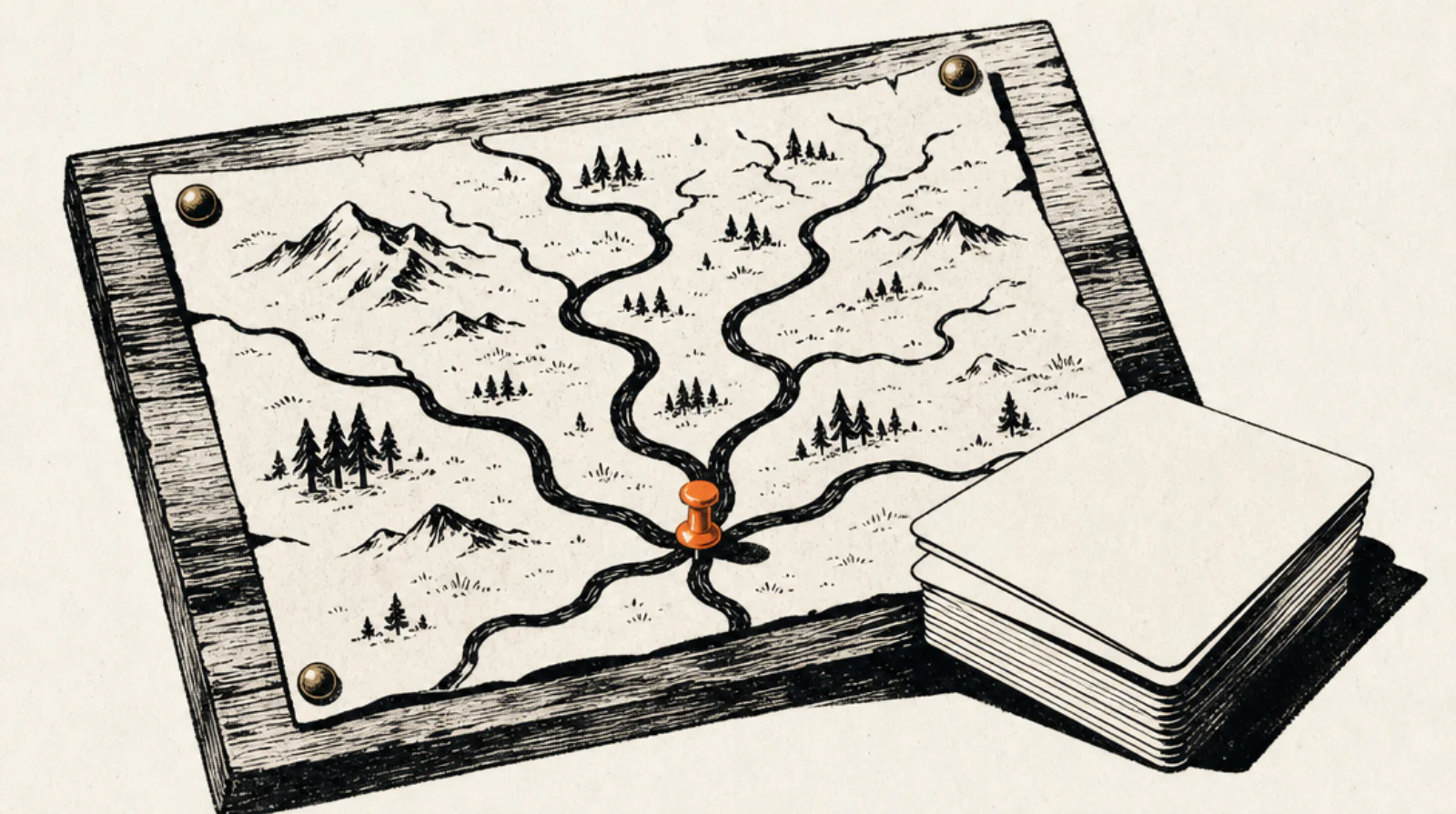
Each act is a map of about 15 floors with three or four paths that cross and merge. Node types: normal fight, elite (harder, better reward), rest site (heal or upgrade a card), shop, unknown event, treasure. Generate it by walking several random paths from bottom to top and merging overlapping nodes, then apply rules:
- No elites or rest sites in the first few floors.
- Never two rest sites in a row on one path.
- A treasure node in the middle of the act, and a rest site right before the boss.
- Show the boss at the top from the start, so players draft toward it.
Persistent passive items (the genre calls them relics) drop from elites, treasure and bosses: "start each fight with 1 extra energy", "the first card each turn costs 0". They define a run as much as the cards. The roguelike guide covers run structure and what carries over between runs.
Three twists that make it yours
- 01Position matters. Fight on a short row of lanes: cards push enemies back, pull them close, or hit everything in a column. Combat becomes a tiny tactics game.
- 02Cards that age. Every card has a durability; using it wears it down and eventually it breaks, but upgraded cards last longer. Deck management becomes repair and replacement.
- 03A shared deck for a duo. Two heroes draw from one deck, and each card is better in one hero's hands. Who plays what becomes the puzzle.
A brief to paste into Startbase
A roguelike deckbuilder for desktop and phones with a clean storybook look: ink lines and watercolor washes. The hero is a wandering cartographer crossing a chain of floating islands to finish a map of the sky. Combat is turn-based: each turn draw 6 cards and refill 4 wind points; cards cost 0 to 3. Battles take place on three lanes; cards can hit a lane, push an enemy back a lane or pull it closer, and enemies in the front lane deal full damage while those behind deal half. Each enemy shows its next move above its head (attack with a number, guard, buff, debuff). Start with 10 basic cards and 70 health that carries between fights. After each fight, choose 1 of 3 cards or skip; rare odds rise each time a rare is missed. A sky chart of 15 stops per act with branching routes: fights, tough fights, markets (with a card removal service), campfires (heal or upgrade a card), ruins (events) and a boss at the top, visible from the start. Passive trinkets drop from tough fights and bosses. 3 acts, 60 cards, 20 trinkets, 12 enemies and 3 bosses for a first version, all cards defined as data. Newly found cards and trinkets join the pool for later runs, saved on the device.
For a head start on card visuals and pacing, the card battler prompt is a good companion. Publish with one click and share it to the Arcade when it is ready.
Common mistakes
- Hidden enemy actions. Without intents the game becomes luck. Show them.
- Forced card picks. Always allow Skip, or decks bloat and every run feels the same.
- Too many statuses too early. Start with four and make each one obvious on screen.
- Effects written as code per card. You will want 100 cards. Define effects once and compose cards from them.
Frequently asked questions
What is a roguelike deckbuilder?
A game where each run starts with a small deck, you add and remove cards as you progress through randomized fights and events, and losing ends the run so you start fresh with new choices.
How many cards does a deckbuilder need?
For a first version, around 60 to 80 cards is enough if they support a few distinct strategies. Build effects as reusable data and adding more later is quick.
Why do enemies show their next move?
Visible intents give the player full information, so each turn becomes a planning puzzle rather than a guess. It is the main reason the genre feels fair.
Can I use Slay the Spire cards or relics in my game?
No. Its cards, relics, characters and art belong to its developer. Design your own cards and theme; the genre systems are shared design ideas.

