How to Make a Horror Game in the Browser
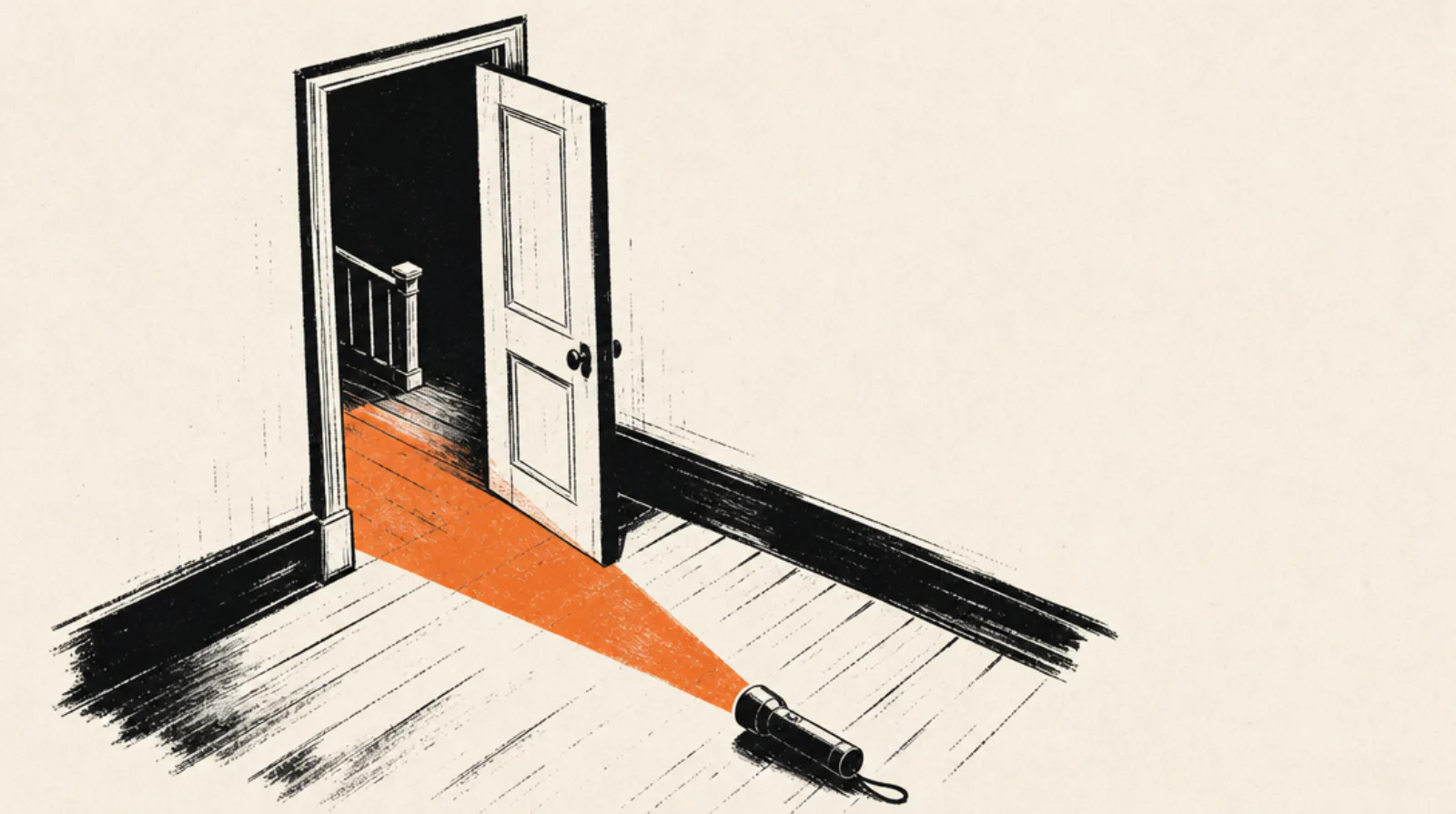
Horror is the genre where restraint wins. A small house, a flashlight, a good soundscape and a monster you rarely see will beat any number of jump scares.
Key takeaways
- Fear lives in anticipation. Plan tension as a curve of build, peak and release, and spend scares rarely.
- Sound does more than visuals: an ambient bed, positional noises and deliberate silence.
- Darkness should hide the threat, not the path. Players must always find the way forward.
- Browsers block sound until the player interacts, so start every horror game with a click-to-begin screen.
To make a horror game in the browser, keep the space small (one house, one ship, one forest clearing), give the player limited light, build the fear with sound before visuals, and pace the game as waves of rising tension with quiet stretches between. A first-person 3D game in Three.js or a dark top-down 2D game both work. What does not work is a stream of jump scares: after the third, players stop being afraid and start being annoyed.
Pace tension like a heartbeat
Horror is a rhythm of build, peak and release. The player explores, notices something wrong, the dread builds, something happens (or nearly happens), then there is a short calm before the next build. Plan this on paper as a sequence of beats for a 20 to 40 minute game:
- 01Normal. The first few minutes look ordinary. A kitchen, a hallway, a note on the fridge. Normality is what makes the wrongness land later.
- 02Wrongness. Small, deniable signs: a door that was closed is open, a sound upstairs, a photo turned face down.
- 03Threat confirmed. A glimpse of something at the end of a corridor, gone when you look again.
- 04Pressure. The threat is now active. The player has a goal (find three keys, restore power) and must move through dangerous space.
- 05Climax and release. A chase or a confrontation, then an escape, an ending or a safe room before the next act.
Budget jump scares like money: two or three in a 30-minute game, each earned by a long quiet build. A false scare (a cat knocking over a pan) right before a real one is a classic for a reason. The difficulty curve guide shows the same rhythm of pressure and release in other genres.
Sound is the scariest thing you have
Close your eyes during a horror film and it is still scary. Mute it and it is not. For a browser horror game, sound design is the highest-return work you can do:
- An ambient bed that never fully stops: wind, a hum, distant creaks. Low and continuous.
- Positional sounds that come from a direction in the 3D space: footsteps above, a door to the left. Browser audio can pan and fade sounds by their position relative to the player.
- Silence as a signal. Cut the ambience suddenly before something happens. Players notice the absence of sound more than any noise.
- The player's own sounds: footsteps on wood versus tile, breathing that quickens when the threat is near.
- Stingers (a sharp sound on a scare) used rarely.
Startbase's agent can generate sound effects, ambience and music for a game, so you can ask for "a 90-second loop of an old house at night with wind and occasional creaks" and get a file in the project. Suggest headphones on the start screen. The sound effects guide covers variation and mixing, and AI-generated sound for games covers generating ambience.
Darkness that hides the threat, not the path
Darkness is the horror designer's main tool and the main source of player frustration. The rule: players should never be lost because it is dark, only afraid. Techniques:
- A flashlight cone gives the player control over what they see and leaves everything else to imagination. A spotlight attached to the camera in 3D, a light mask in 2D.
- Limited battery or flicker adds pressure, but should never trap a player in total black. Let batteries be common enough.
- Navigation lights: a lit doorway, a glowing exit sign, moonlight through a window. Light is how you lead the player.
- Fog in 3D limits how far the player sees and makes shapes emerge rather than appear.
- A brightness check at the start ("adjust until the symbol is barely visible"). Screens vary hugely, and a game tuned on a bright monitor can be pitch black on a phone outdoors.
In a 3D Startbase game, the World Editor lets you place lamps, spotlights and glows by hand and set fog distances and the time of day to night in the Look panel. Turn on Lit to see the level as players will, and the work light off. On slower phones, the engine draws fewer lights and effects so play stays smooth, so test the scariest room on a phone.
The monster: rarely seen, always felt
A monster seen clearly and often stops being scary. A simple enemy behavior that works in small games:
- Patrol between rooms on a route, with sounds that give its position away.
- Investigate when it hears the player (running, a dropped object, a door slammed) and walk to the noise.
- Chase when it sees the player within range and line of sight, with a clear audio cue.
- Lose interest after a few seconds out of sight, and return to patrol.
Give the player counters that are not combat: hiding spots (a closet, under a bed), walking quietly, closing doors. Being powerless is what makes horror horror. If the player can fight back easily, it becomes an action game. Enemy AI behaviors covers the state machines behind a monster that patrols, hears and hunts.
A horror game brief to paste
A first-person 3D horror game in the browser, about 25 minutes. Setting: a two-floor farmhouse at night during a storm. Low-poly but moody: night lighting, fog, rain sound outside. The player has a flashlight (spotlight from the camera) with a slow-draining battery and batteries in drawers. Goal: find three fuses to restore power and open the cellar door. A tall figure patrols the upstairs, makes footstep sounds, walks to noises the player makes, chases on sight for up to 8 seconds, then returns to patrol. Hiding spots in two closets and under a bed. Pacing: first 5 minutes quiet with small wrong details, the figure is glimpsed once at 6 minutes, active from the first fuse onward. Two jump scares maximum. Ambient sound bed, positional footsteps, silence before the figure appears. Click-to-begin title screen with a headphones suggestion and a brightness check. Desktop: WASD and mouse look with pointer lock. Phone: joystick and drag to look.
After the first build, play it in the dark with headphones and report feelings, not code: "the hallway is not scary because I can see the whole thing", "the figure appears too often". One note per message works best. Save a checkpoint before changing the monster behavior, so you can compare versions.
Browser-specific limits to plan around
- Audio needs a click first, as above.
- Mouse look needs pointer lock, which the browser grants after a click and releases on Escape. Pause the game when it is released.
- Phones are played in bright places. Make the brightness check matter, and consider a slightly lighter default on touch devices.
- Fullscreen helps immersion. Offer a fullscreen button; the Arcade also lets players go full screen.
- Keep it light on memory. One house with reused props loads faster than a large map, and a horror game that takes a minute to load loses its mood before it starts.
Horror mistakes to avoid
- Scares from minute one. Without normality, nothing is wrong.
- Too dark to navigate. Frustration kills fear.
- A monster that kills instantly with no warning. Players need a moment of "it saw me" to feel fear rather than surprise.
- Long walks back after dying. Respawn close to where the player died, with the tension reset a little.
- Gore instead of dread. Shock wears off quickly. Uncertainty lasts.
For 3D groundwork (camera, lighting and scope), see how to make a 3D game without coding, and for more genres the same tools cover, the games use case.
Frequently asked questions
Can you make a scary game in a web browser?
Yes. Browser 3D graphics handle dark, foggy, low-poly scenes well, and positional audio works in modern browsers. Small spaces, good sound and careful pacing are what make it scary.
How many jump scares should a horror game have?
Very few. Two or three in a 30-minute game, each after a long quiet build, works better than frequent scares that players quickly become numb to.
Why is there no sound when my browser game starts?
Browsers block audio until the player interacts with the page. Start with a title screen and a click or tap to begin, then start the audio.
Should a horror game let the player fight back?
Usually not, or only weakly. Hiding, sneaking and running keep the player vulnerable, which is the core of horror.

