How to Make a Racing Game
An arcade racer lives or dies on three things: how the car turns, how the track flows and whether there is someone to beat. Here is how to get each one right.
Key takeaways
- Arcade handling is a set of deliberate cheats: high grip, steering that softens at speed, and a drift that rewards rather than punishes.
- Design the track as a sequence of corners with names, and give the player landmarks to brake by.
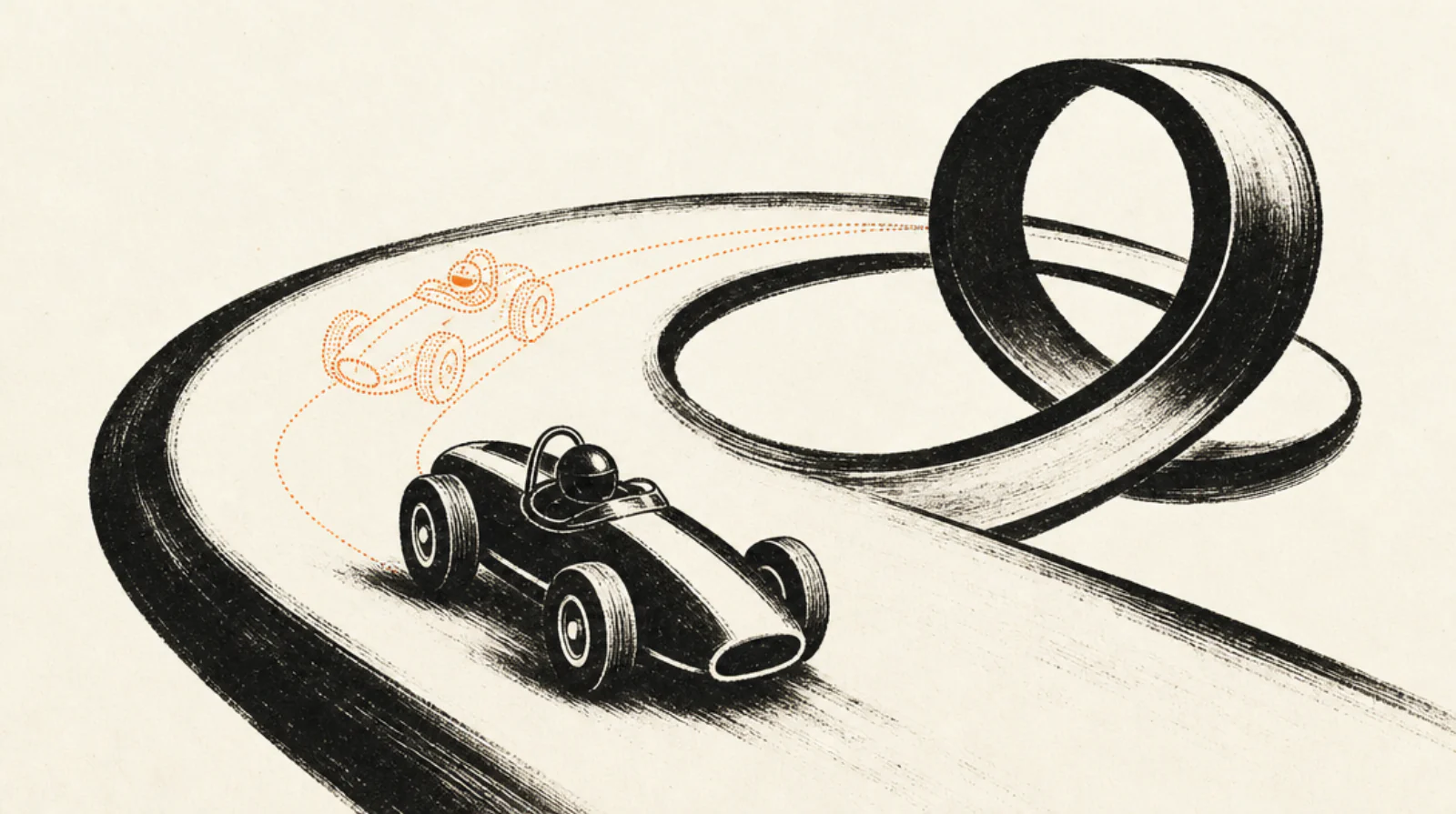
- Ghost laps are the cheapest rival you can build: record position samples, replay the best lap as a see-through car.
- Close-contact online racing needs specialist netcode. Ghosts and time leaderboards give a competitive game without it.
To make a racing game that people replay, build arcade handling first, then one well-shaped track, then a ghost of the player's best lap to race against. Realistic simulation is a trap for a first racer: real tire physics is hard to tune and not much fun with a keyboard or touch screen. Arcade racers like the kart and street-racing classics feel great because they bend physics in the player's favor on purpose.
Arcade handling: the honest cheats
Arcade handling is not a lack of physics. It is physics with a few values set where they feel good instead of where they are realistic. Ask for these by name in your brief:
- High lateral grip. The car goes where it points. Sideways sliding is something the player chooses (drifting), not something that happens by accident.
- Speed-sensitive steering. Full steering lock at low speed, about half at top speed. Without this, a car that turns nicely in town snaps into the wall on the straight.
- Fast acceleration, slow top-speed creep. Reach most of top speed in two or three seconds, then gain the last bit slowly. Getting back up to speed after a mistake should not feel like a punishment.
- A drift that pays. Holding a drift button through a corner tightens the turn and charges a small boost on release. This is the skill layer of most kart games.
- Soft walls. Hitting a barrier at a shallow angle should scrape and slow you, not stop you dead or flip you over. Push the car back along the wall direction.
- Auto-righting. If the car ends up upside down or stuck, reset it onto the track after a second.
Startbase builds 3D games on Three.js with Rapier physics available. A full rigid-body car with suspension looks impressive but is fiddly; a simpler controller (a body that slides on the road with steering and grip values you control) is easier to make fun. Say which one you want. Put top speed, grip, steering at speed and drift strength on live Engine dials so you can tune while driving. The game camera guide covers giving the player more view as speed rises.
Selling speed without going faster
A car moving at a high number on screen does not feel fast by itself. Speed is a feeling built from the camera and the scenery:
- 01Widen the camera's field of view a little as speed rises, and pull the camera slightly back.
- 02Put objects close to the road: fences, posts, trees, light poles. Things streaming past at the edge of the screen sell speed. An empty desert feels slow at any number.
- 03Add a slight camera shake at top speed and a kick when boosting.
- 04Use sound: engine pitch rising with speed, wind noise, a whoosh when passing objects.
- 05Add speed lines or particles only during boost, so they mean something.
Track design: corners, rhythm and landmarks
A good track is a sequence of corners with a rhythm, not a random loop. Sketch it as a list before you build it:
- Mix corner types. A hairpin (slow, hard braking), a sweeper (long, fast, held at the edge of grip), a chicane (quick left-right), and a kink you can take flat out. Each one asks for a different skill.
- Follow fast with slow. A long straight into a hairpin is the classic overtaking spot and the place a boost matters most.
- Make the track wide. Arcade tracks are often three or four car widths wide. Narrow tracks punish small errors and make drifting impossible.
- Give braking landmarks. A billboard, a tree, a bridge. Players learn "brake at the red sign" and improving lap times feels like their skill.
- Show the next corner. Use chevron signs, a bend in the barriers or elevation so the player sees where the road goes before they get there.
- Keep a lap between 40 and 90 seconds. Short enough to retry, long enough to have a shape.
Place barriers, signs and scenery by hand in the World Editor: duplicate a fence post and the next copy lands the same distance along, and the Look panel sets the time of day for the whole track. Ask the agent for the road itself and the racing logic, then dress the track yourself.
Ghost laps: a rival without a server
A ghost is a see-through car that replays your best lap. It turns a solo time trial into a race, and it is far simpler than live multiplayer. The data model is small:
- While driving, sample the car's position and rotation about 15 to 20 times a second, with the time since the lap started.
- When a lap finishes faster than the stored best, replace the stored ghost with this lap's samples.
- On the next lap, replay the samples, smoothly interpolating between them, as a transparent car with no collision.
- A 60-second lap at 20 samples a second is 1,200 samples, small enough to store in the browser.
Recording positions rather than button presses matters. Replaying inputs only works if the physics is perfectly deterministic, and browser physics with variable frame times usually is not, so input ghosts drift off the road after a few corners. Position ghosts are always exactly where you were.
Want ghosts from other players? Store the fastest lap per track in a database and let players race the world record ghost. With Startbase Cloud attached, the agent can add a database table for lap times and ghosts plus sign-in so each time has a name. Validate submissions loosely (reject laps faster than physically possible) because any browser leaderboard can be cheated by a determined player. The leaderboards guide covers the defenses that make cheating hard.
A racing game brief to paste
A 3D arcade racing game in the browser with low-poly cars and a sunny coastal track. Third-person chase camera behind the car; field of view widens slightly with speed. Arcade handling: high grip, steering reduced at high speed, reach near top speed in about 3 seconds, a drift button that tightens turns and gives a short boost on release, soft barriers that scrape instead of stopping the car, auto-reset if stuck. One track, about 60 seconds a lap: long straight into a hairpin, a fast sweeper along the cliff, a chicane through a village, a tunnel. Billboards as braking markers, fences and palm trees close to the road. Three-lap time trial with a lap timer and best lap. Record the best lap as a transparent ghost car and replay it. Keyboard arrows plus space to drift; phone: tilt-free on-screen left and right buttons on the left thumb, gas and drift on the right. Put top speed, grip and drift boost on Engine dials.
What about online racing against friends?
Live wheel-to-wheel racing over the internet is one of the hardest multiplayer problems in games. Cars move fast, so a tenth of a second of delay puts another car a few meters away from where your screen shows it, and collisions between cars become arguments between two computers. Professional racers solve this with prediction and correction code tuned over years.
Startbase can build games with a room server, and publishing it with the game works on paid plans, but it is best suited to party, turn-based and light realtime play. For a racer, the honest, fun options are ghost races, shared time leaderboards, or casual races where cars pass through each other so collisions never need to agree. Our multiplayer guide covers where rooms fit.
Common racing game mistakes
- The camera rigidly locked to the car. Every bump shakes the view. Use a chase camera that eases into position.
- Heavy rubber-banding against AI. AI cars that magically catch up feel unfair. If you add AI, give it a small, visible catch-up boost or none.
- Invisible track limits. If cutting a corner is not allowed, show it with grass that slows the car, not an invisible wall.
- No restart button. Time-trial players restart constantly. Make it one key or tap, and instant.
- Grey on grey. Road, barriers and scenery in similar tones hide the next corner. Keep the road dark and the edges bright.
When the track feels right, publish it to a link and share it in the Arcade, or browse the games use case for other genres the same tools handle. Long tracks with lots of scenery are where phones struggle, so read the phone performance guide before adding more.
Frequently asked questions
What makes a racing game feel good?
Responsive handling that forgives small mistakes, a strong sense of speed from the camera and nearby scenery, and a track with varied corners and clear braking landmarks.
How do ghost cars work in racing games?
The game records the car's position and rotation many times per second during a lap, saves the best lap, and replays those samples as a transparent car on the next attempt.
Can I make an online multiplayer racing game in the browser?
Casual online races are possible, but close-contact racing with collisions needs specialized netcode. Ghost races and shared leaderboards give competition without that complexity.
Should a beginner make a realistic or arcade racer?
Arcade. Realistic tire and suspension physics is hard to tune and rarely fun on a keyboard or phone. Arcade handling lets you choose how the car feels.

