How to Make a Simple Sports Game
Simple sports games are one gesture plus good physics: drag and release for a putt, swipe for a kick. Here is how to tune both so every shot feels earned.
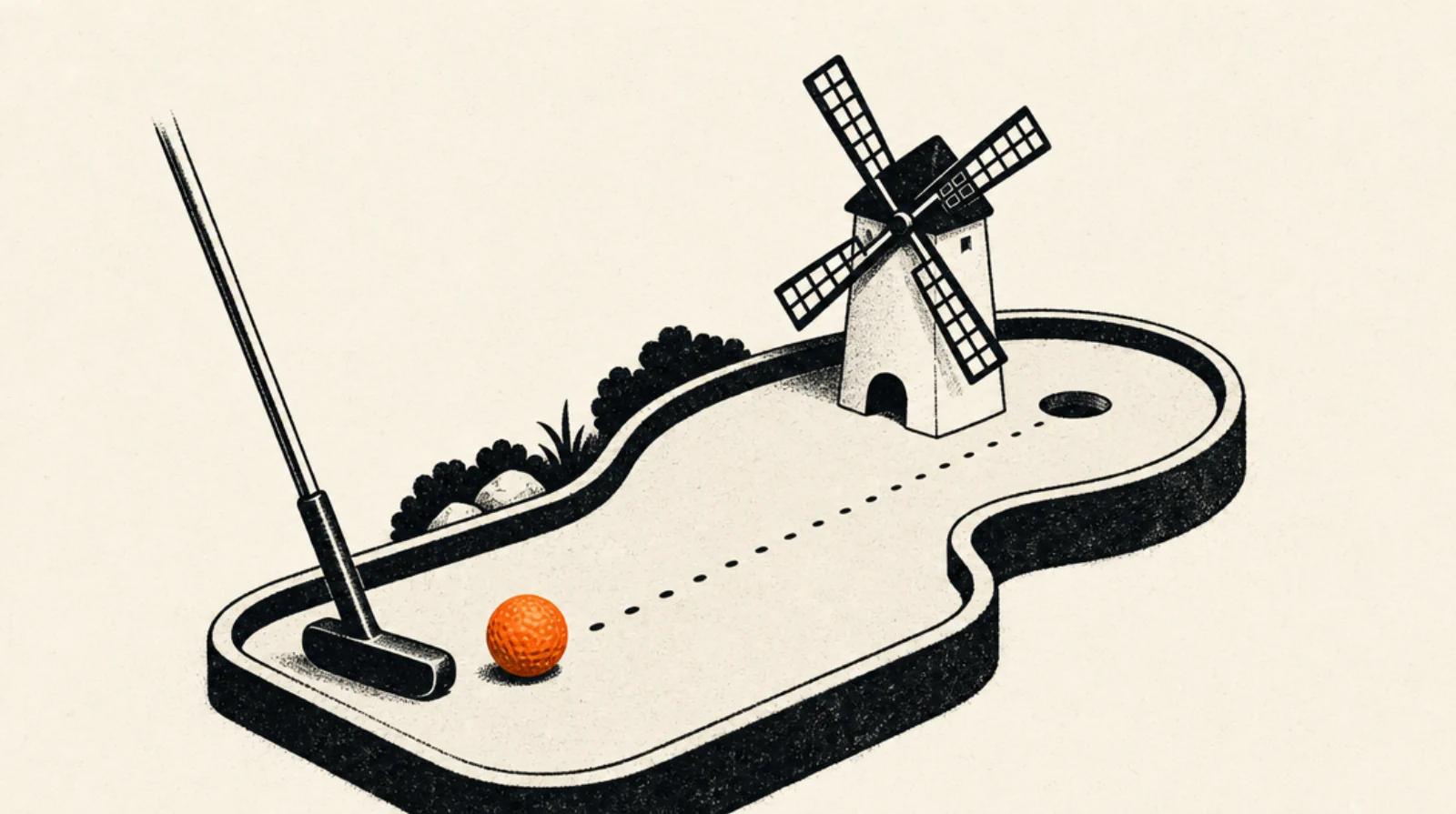
Key takeaways
- Pick one sport moment, not a whole sport: a putt, a penalty, a free throw, a bowling frame.
- Design one input gesture with a clear aim and a clear power, and show both before the shot.
- Arcade physics means tuning friction, bounce and gravity for feel, then guarding against fast-ball bugs.
- Short rounds with a score to beat (par, goals out of five, a streak) drive replays.
To make a simple sports game, take one moment from a sport (a putt, a penalty kick, a free throw), give it one satisfying input, and run it on arcade physics tuned for feel rather than realism. Mini golf and penalty shootouts are the classic first projects because the rules are known to everyone, rounds take seconds, and the physics is limited to one ball. A full football or basketball game with teams, AI and tactics is a much larger project; a perfect single moment is a finished game.
Pick one moment of the sport
The simple sports games people replay focus on a moment that is already dramatic. Good candidates:
- Mini golf: aim and power for each putt, obstacles that make holes puzzles.
- Penalty kicks: shooter picks placement and power, the keeper guesses. Then switch roles.
- Basketball free throws: arc and timing, streaks for consecutive makes.
- Bowling: aim, spin and the pleasure of pins falling.
- Archery or darts: aim with wind or wobble, score rings.
- Table sports: air hockey, table football, pool. Small arena, constant action.
One gesture, clearly shown
The input is the game. It should feel physical and be readable before the shot:
- Drag and release (mini golf, pool, archery): pull back from the ball like a slingshot. Direction is the opposite of the drag, power is the drag length up to a cap. Show a dotted aim line and a power meter while dragging. Cancel by dragging back to the ball.
- Swipe (penalties, basketball, bowling): the swipe direction sets the aim, speed sets the power, and a curve in the swipe adds spin. Read the swipe from its last part, not its start, where most fingers wobble.
- Timing meter (golf drives, darts): a needle sweeps, tap to stop it for power, tap again for accuracy. Old-school, very clear, works with a mouse and a thumb.
Arcade physics: tune for feel
Real physics is the starting point, not the goal. Startbase 3D games run on Three.js with Rapier physics available, and 2D games can use simple physics in code. Either way, the values that matter are few:
- Rolling friction: how quickly the ball slows on the green. Too low and putts roll forever, too high and they die short. Most of the feel of mini golf is this one number.
- Restitution (bounciness): how much speed a ball keeps after hitting a wall. Around 0.6 to 0.8 makes bank shots fun.
- Gravity: often stronger than real for snappy arcs in basketball, or weaker for floaty fun.
- Spin and curve: an arcade curve applied over the flight, not a full aerodynamics model.
- Max power: a cap so no shot can fly off the course.
Put each one on a live Engine dial and tune while playing. A minute of adjusting friction on a dial beats ten rounds of chat messages about the ball "feeling floaty". The game feel and juice guide covers the hit stop and sound that make a strike feel solid.
The physics bugs every sports game hits
- 01Tunneling: a fast ball passes through a thin wall because it moved past it between two physics steps. Fix with thicker walls, a speed cap or continuous collision detection for the ball.
- 02Never-ending roll: the ball creeps at tiny speed forever. Stop it below a speed threshold and end the shot.
- 03Lip-outs that are not fun: a ball rolling over the cup at speed should skip it, but a slow ball near the center should drop. Use a capture rule: if the ball is within the cup and below a speed, it goes in.
- 04Frame-rate dependence: physics must run on a fixed timestep, or the same shot travels differently on a fast monitor and a slow phone.
- 05Ball stuck in geometry: after a reset or a hard hit, the ball can rest inside a corner. Add a stuck check and a reset to the last position.
Mini golf: hole design as puzzles
Each mini golf hole is a small puzzle with a par. Nine holes is a full course. A healthy mix:
- Two straight warm-up holes, par 2.
- A bank shot hole where the direct line is blocked.
- A slope hole where the ball curves.
- A moving obstacle: windmill, swinging gate, rotating bar. Timing matters.
- A ramp jump or a tube that sends the ball to a lower level.
- A risk-reward hole: a narrow shortcut for a hole in one, or a safe long route.
- A signature final hole that everyone will remember.
In a 3D game, arrange walls, ramps and obstacles by hand in the World Editor: its shapes include boxes, ramps, cylinders and discs that snap together face to face, Motion makes an obstacle spin or swing on its own, and the Colliders view shows exactly what the ball will hit. Press P to play from the camera and try a single shot.
Penalty kicks: the keeper makes the game
In a penalty game, the keeper is the opponent, so its behavior is the design. A fair arcade keeper picks a dive direction with a small reaction delay, has a reach that covers most of the goal but not the corners, and occasionally guesses early. Corners are high reward and high risk: shots aimed close to the post can go wide. Then flip roles: the player is the keeper and swipes to dive while the computer shoots. Five shots each, sudden death if tied, is the familiar format. The enemy AI guide covers reaction delays and deliberate mistakes that keep a computer keeper beatable.
A sports game brief to paste
A 3D mini golf game for the browser, bright toy-like low-poly look on floating islands. Controls: drag back from the ball like a slingshot, with a dotted aim line showing only the first segment and a power meter; drag back onto the ball to cancel. Physics: rolling friction, wall bounce around 0.7, a max power cap, fixed timestep, continuous collision for the ball, the ball stops below a small speed, and it drops into the cup only when within the cup and slow enough. Nine holes with par: two warm-ups, a bank shot, a slope, a windmill, a ramp jump, a tube to a lower level, a risky shortcut hole, and a big finale. Ball out of bounds returns to the last spot with a penalty stroke. Scorecard after each hole and at the end, best total saved in the browser. Satisfying sounds for the putt, wall bounce and cup. Camera behind the ball while aiming, follows during the roll. Put friction, bounce and max power on Engine dials. Works with touch and mouse.
Local multiplayer is natural for these games: pass the phone between shots. Online turn-based play (each player takes their putt) is also light enough for a room server; see the multiplayer guide for how rooms work. For a ready audience, publish and share it to the Arcade, where players swipe from one game to the next and a quick sports game fits well. Single shots also suit a daily leaderboard for the best score of the day.
Sports game mistakes
- Realistic means slow. Realistic friction and gravity often feel sluggish. Tune for feel.
- Hidden aim. If players cannot see where they are aiming, misses feel random.
- Long resets. After a shot, the next one should be ready in about a second.
- Unreadable power. A drag with no power meter makes every shot a guess.
- Too many sports in one game. One sport done well beats five done loosely.
For more on 3D camera and scope, see how to make a 3D game without coding.
Frequently asked questions
What is the easiest sports game to make?
Mini golf or penalty kicks. Both use one ball, one input gesture and short rounds, and everyone already knows the rules.
Why does my ball go through walls?
It moves farther than the wall's thickness in one physics step, which is called tunneling. Use thicker walls, cap the ball's speed or turn on continuous collision detection for the ball.
Should a sports game use realistic physics?
Use physics as a base, then tune friction, bounce and gravity for fun. Arcade values usually feel better than realistic ones on a screen.
Can I make a full soccer or basketball game?
It is a much bigger project with team AI, tactics and animation. Start with one moment, like penalties or free throws, and expand once that feels great.

