How to Make an Obstacle Course Game (Obby)
An obby is a ladder of short stages where every death costs seconds, not minutes. The craft is in fair hazards, honest colors and a ramp that keeps players climbing.
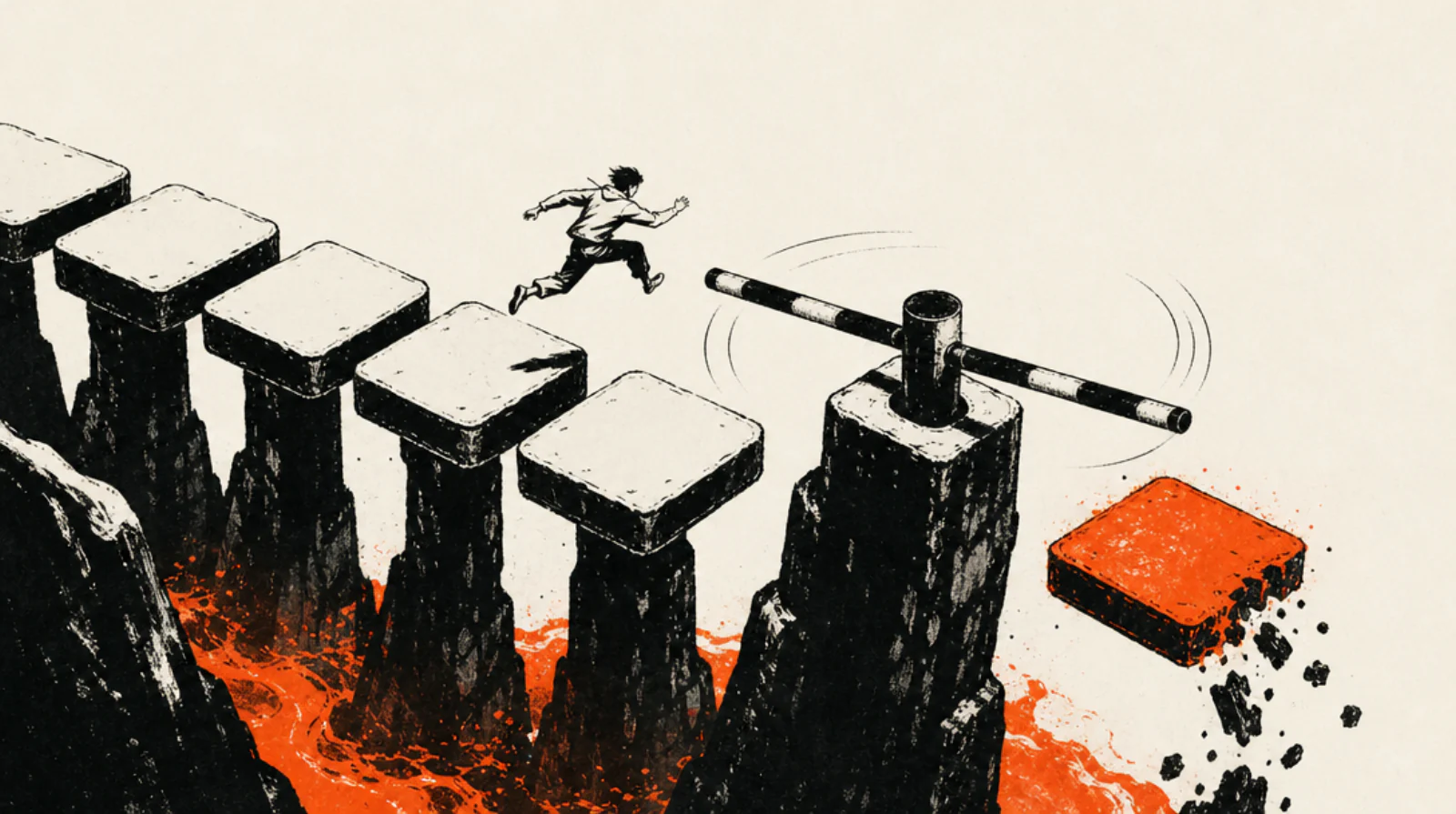
Key takeaways
- An obby is many tiny stages with a checkpoint each. The stage number is the progress bar and the bragging right.
- Build a small hazard vocabulary with one color rule (for example, red always kills) and never break it.
- Every timed hazard must show its timing before it hurts you.
- Ramp difficulty in waves: three easier stages after every spike, and a new hazard introduced where failing is cheap.
An obstacle course game, often called an obby, is a chain of short numbered stages: jump across platforms, dodge a spinner, cross a disappearing bridge, touch the checkpoint, repeat. To make one, define a handful of hazards with consistent rules, build 20 to 50 stages that each take 10 to 40 seconds, put a checkpoint at the end of every stage and ramp the difficulty in waves. The format took off on Roblox because it is simple to understand, fast to retry and endlessly extendable. The same structure works as a 3D browser game you can share with a link.
How an obby differs from a platformer
An obby uses platformer movement, but its design is different. A platformer has levels with pacing, exploration and secrets. An obby is a ladder. Each stage is one idea, checkpoints are everywhere, and the stage counter ("Stage 37") is both the progress bar and the thing players brag about. Players are not exploring. They are climbing, dying, retrying and climbing again. The difficulty curve guide explains how to space hard stages with easier ones.
- Stages are short: 10 to 40 seconds for a player who knows the route.
- Checkpoints are constant: one per stage, so a death never costs more than one stage.
- Death is cheap: instant respawn on the stage's checkpoint, no lives, no game over.
- Progress is a number: the current stage, the best stage reached, and often a total death counter that players find funny rather than shameful.
Build a hazard vocabulary
Pick eight to twelve hazards and give each one a fixed look and rule. Players learn the vocabulary in the first ten stages and then read every new stage at a glance. A starter set:
- 01Kill tile: touching it respawns you. One color only, used for nothing else.
- 02Gap jump: platforms with spaces between them, the basic unit.
- 03Spinner: a rotating bar at ankle or head height that knocks you off.
- 04Disappearing platform: fades or flashes for about a second, vanishes, then returns on a fixed cycle.
- 05Moving platform: slides back and forth on a visible track.
- 06Conveyor: a floor that pushes you, marked with arrows.
- 07Bounce pad: launches you higher than a jump. Distinct color and a squash animation.
- 08Truss or ladder: climbable vertical section.
- 09Wall hop: narrow ledges around a corner.
- 010Ice: low friction floor in a pale blue, where stopping takes time.
What makes a hazard fair
Obby players accept hard. They do not accept unfair. The difference comes down to whether the player could have known:
- Visible timing. A disappearing platform flashes before it vanishes. A spinner can be watched for a full rotation from safety before you commit.
- Safe observation spots. Every stage starts on a platform where nothing can hurt you, so players can read it first.
- Consistent cycles. Timed hazards follow a fixed loop, not a random one. Randomness in a precision game feels like the game cheated.
- Hitboxes that match the art. If the spinner looks thin, its collider should be thin. Taller or wider invisible colliders are the top complaint in obstacle games. The World Editor's Colliders view draws what the game actually collides with, so you can check.
- No blind jumps. If the landing is out of view, put a marker or a coin there.
A difficulty ramp in waves
A straight line of rising difficulty exhausts players. A wave keeps them going. A pattern that works for a 30-stage obby:
- Stages 1 to 5: one hazard each, generous spacing. Teach gap jumps, kill tiles, a spinner.
- Stages 6 to 10: introduce disappearing and moving platforms where a fall drops you onto the same stage, not the start.
- Stage 10: a small spike that combines two hazards.
- Stages 11 to 13: easier again, a breather with something fun (a bounce pad chain).
- Stages 14 to 20: combinations and tighter timing.
- Stage 20: a showpiece stage, visibly different and harder.
- Stages 21 to 30: the hard tail for players who want it, ending in a big finish platform.
Introduce every new hazard where failing is cheap and the hazard can be seen alone. Only combine it with others after the player has beaten it once.
Building stages with an editor
An obby is the genre where placing things by hand pays off most. Ask the agent to build the hazards as reusable pieces with dials (spinner speed, platform cycle time, gap length), then lay out stages yourself in the World Editor. Its shapes (boxes, discs, ramps, cylinders) snap face to face, ⌘D duplicates a platform the same distance again, and Motion on a thing makes it spin, bob or sweep without code. Press P to play from where the camera is, so testing stage 23 does not mean beating 22 stages first.
Save a checkpoint before asking for big changes to movement. Changing jump height after 30 stages are built can break every gap, which is why you lock the jump before building the ladder. Checkpoints and undo explains how saved versions work while you build.
An obby brief to paste
A 3D obby (obstacle course) for the browser, bright low-poly style floating over a lava sea. Third-person camera behind the player. Movement: run, jump with coyote time, no double jump. 30 numbered stages, 10 to 40 seconds each, a checkpoint pad at the end of each stage that turns green when touched, and instant respawn on the last checkpoint when touching lava or a red tile. Red always means deadly and is used for nothing else. Hazards: gap jumps, spinners, platforms that flash for one second then vanish for two, moving platforms on visible rails, conveyors with arrows, bounce pads, ice. Build each hazard as a reusable piece with dials for speed and timing. Introduce one new hazard every few stages; stage 20 is a showpiece. HUD: current stage, best stage, deaths. Save best stage in the browser. Keyboard WASD and space; phone joystick and jump button.
The social layer: seeing other climbers
Part of the appeal on platforms like Roblox is climbing alongside other people: you see someone stuck on stage 14 and someone breezing past on 22. You can add a light version of that. Showing other players' positions in a shared room is light realtime and fits a room server, which Startbase previews run on every plan and publishes with the game on paid plans. Players do not collide with each other, so the realtime demands stay modest. See how to build a multiplayer game for the room model.
Lighter still: a leaderboard of best stage and fastest full-course time, stored in a database with sign-in. Players compete without ever being online together. The leaderboards guide covers daily boards and fair scores.
Mistakes that make players quit
- A wall at stage 3. Early stages exist to hook players, not filter them.
- Long falls back to the start. If falling off stage 15 lands you on stage 12, put a kill zone beneath and respawn on 15.
- Same-looking stages. Change the color theme or setting every ten stages so progress feels like travel.
- Camera fights in tight spaces. Wall hops around corners need the camera to move closer, not clip through.
- Hidden routes as the only way. Secret paths are fine as shortcuts, never as the required route.
For camera and jump foundations shared with other 3D games, read how to make a 3D platformer. When your course is ready, publish it and share it to the Arcade.
Frequently asked questions
What is an obby?
An obby is an obstacle course game made of many short numbered stages, each with a checkpoint. The name comes from the Roblox community, where it is one of the most popular formats.
How many stages should an obby have?
Twenty to fifty is a good first target. Short stages with checkpoints matter more than the count, and you can add stages later without changing the rest.
Can I make an obby outside Roblox?
Yes. An obby is a 3D platformer structure, and it works as a browser game that anyone can play from a link, on a phone or a computer, with no install.
How do I make obby hazards feel fair?
Give each hazard a consistent look, show its timing before it can hurt, start every stage on a safe platform and make collision shapes match what players see.

