A Prompt for a Cooking Rush Game
A complete brief for a time management cooking game, with the order flow and timers spelled out, then three follow-ups, two variations and the usual difficulty bugs.
Key takeaways
- Write the recipes as steps through stations with times. A cooking game is a set of parallel timers, and the agent needs the numbers.
- Give every timer a visible warning before it fails. Burns and walkouts the player could not see coming feel unfair.
- Ramp pressure across days with one new element each day, not by adding customers alone.
A cooking rush game prompt needs the recipes as steps through stations, the time each step takes, what happens when food is left too long and how customer patience works. Those timers running in parallel are the whole game. The brief below builds a 2D diner with three stations, four menu items and five days of rising difficulty, with drag controls that work on a phone.
The diner brief
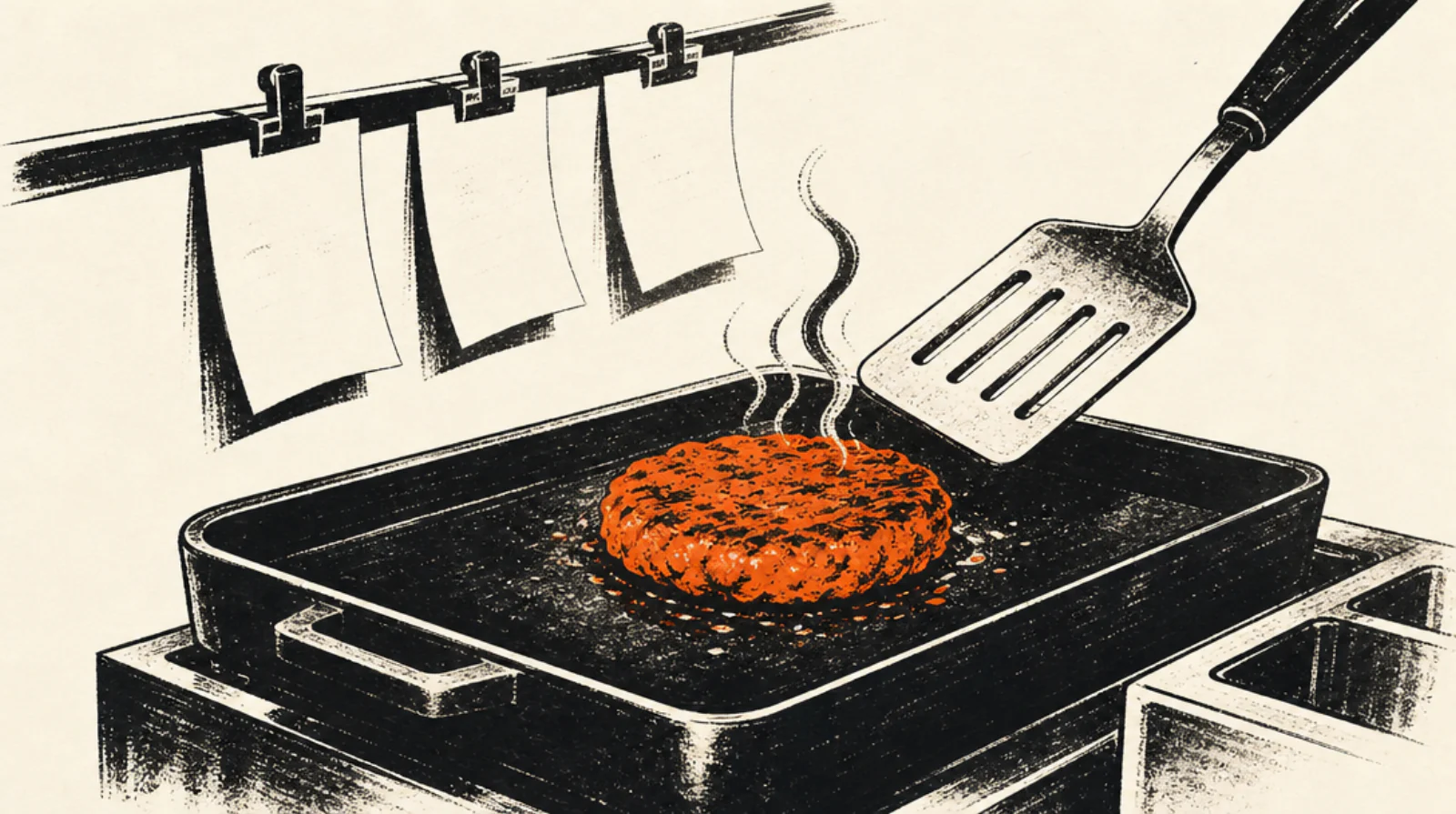
Build a 2D cooking rush game for the browser called Short Order, landscape on phones and tablets, and desktop with a mouse. Scene: a small diner counter seen from the cook's side, four customer seats at the top, the kitchen below. Stations: a grill with three spots, a fryer with two baskets, and a drink machine with two cups. Ingredients in bins: buns, patties, cheese, lettuce, potatoes, cups. Menu: Burger (patty on grill 6 seconds, then onto a bun), Cheeseburger (as burger plus cheese), Fries (potatoes in fryer 5 seconds), Soda (cup under machine 3 seconds). Controls: drag an ingredient from its bin to a station or a plate; drag a finished plate to the customer who ordered it. A tap on a bin then a tap on a target also works. Cooking: each item on a station shows a ring timer; when done it glows and dings; 4 seconds after done it starts smoking, and 3 seconds later it burns and must be dragged to the trash. Customers: arrive at free seats with a speech bubble of 1 to 3 items as icons, and a patience bar of five hearts that drop one by one over 40 seconds. Serve the full order to earn its price plus a tip that is bigger with more hearts left; a customer at zero hearts leaves with a sad puff. Combo: serving three orders in a row without anyone leaving adds a combo tip bonus. Days: each day lasts 3 minutes with a coin target. Day 1 burgers and soda only; day 2 adds fries; day 3 adds cheeseburgers; day 4 adds a fourth seat's faster customers; day 5 is a lunch rush with customers arriving twice as often in the middle minute. Between days an upgrade shop: a fourth grill spot, a faster fryer, an auto drink machine, and slower patience. End of day screen: coins earned, target, stars (1 to 3), customers served and lost. Look: warm retro diner, red and cream, chunky outlines, food that looks delicious. Sound: sizzle loops, fryer bubbling, ding when done, a cash register on payment, upbeat jazzy music that speeds up slightly in the last 30 seconds. Save progress in the browser. First version: five days only.
Why each part is there
- Recipes as station steps with seconds. "Patty on grill 6 seconds, then onto a bun" is exact enough to build and balance. "Make burgers" is not.
- Drag plus tap-tap controls. Dragging feels physical on a touchscreen, but long drags tire thumbs. Offering tap-to-pick and tap-to-place keeps both styles working.
- Done, smoking, burned. Three visible states give the player a warning window. Burning without a warning is the most common reason players call a cooking game unfair.
- Hearts instead of a hidden timer. Patience you can see lets players triage: serve the customer with one heart first.
- Tips tied to hearts, plus combos. Rewards for speed and for streaks make players push, not just survive.
- One new element per day. Each day teaches one thing: a new station, a new item, a faster customer. Players learn the kitchen step by step, which is better than any tutorial screen.
- Upgrades between days. They give coins a purpose and let players choose how to ease the next day, which makes difficulty feel partly in their hands.
Difficulty in time management games is about how many timers run at once. The difficulty curve guide explains how to ramp it, and HUD design for games covers how to show orders and patience without clutter.
The first three follow-up prompts
- 01"Make day 1 a gentle tutorial with no failure: the first customer orders one burger and arrows show each drag, the second orders a soda, and only then does the normal pace start. Skip it automatically on replays."
- 02"Add a stats log for testing: for each day, record how many items burned, how many customers left and the average hearts at serving. Play day 3 with a simple bot that serves the oldest order first and show me the results."
- 03"Let me rearrange the kitchen by hand: build the counter, stations and bins as objects in the level so I can move the grill, fryer and bins in the World Editor and try a different layout without a chat turn."
Two variations
Co-op kitchen chaos
Make it a party game: "Two to four players in a room by link share one kitchen, each controlling a cook character that walks between stations and carries one item at a time. Orders come faster with more players." Shared kitchens are loud, funny and great for friends on a call. See how to make a party game for round structure and lobby ideas; room servers run in previews on every plan and publish with the game on paid plans.
A slow cozy café
Remove the rush: "No patience bars. Customers wait as long as needed and leave a note about their favorite dish. New recipes are discovered by trying ingredient combinations, recorded in a recipe book." It becomes a discovery game with the same stations and art.
What usually goes wrong and how to ask for the fix
- Drags drop in the wrong place. Small targets on phones. Ask: "When I drop an item, snap it to the nearest valid station or plate within 60 pixels, and highlight valid targets while dragging."
- Difficulty spikes on one day. Ask: "Day 4 is much harder than day 3. Show me arrival rates and order sizes per day, and make each day at most 25 percent harder than the last by those measures."
- Everything burns while the player serves. Ask: "The smoke warning is too easy to miss. Make smoking items shake slightly and play a hiss, and pause all timers while the pause menu is open."
- Orders are hard to read. Ask: "Make order icons bigger, show the number of each item as a small badge, and tick off items in the bubble as I add them to the plate."
- Customers wait at empty plates. The order was right but the plate is not delivered. Ask: "When a plate holds exactly what a seated customer ordered, outline that customer, and allow delivering by tapping the plate then the customer."
Frequently asked questions
How do cooking games make difficulty increase?
By adding parallel timers: more stations, more items per order, faster customer arrivals and less patience. Introduce one change per level so players learn each before the next.
Do cooking games work with touch controls?
Yes. Dragging food between stations feels natural on touchscreens. Offer tap-to-pick and tap-to-place as well, and snap drops to the nearest valid target.
How long should a level in a cooking game last?
Two to four minutes is common. Long enough to build up a rush, short enough that a failed day is easy to replay.