A Prompt for a Tower Defense Game
Paste one brief and get a tower defense game with real numbers: four towers with distinct jobs, fifteen waves that teach and then test, and an economy that rewards planning.
Key takeaways
- Give each tower a job, not just a damage number: single target, splash, slow and long range. Roles create decisions.
- Write the wave table into the brief, including which wave introduces which enemy. The table is the difficulty curve.
- Fixed build pads beat free placement on phones: big tap targets, no accidental builds, and a map you can balance.
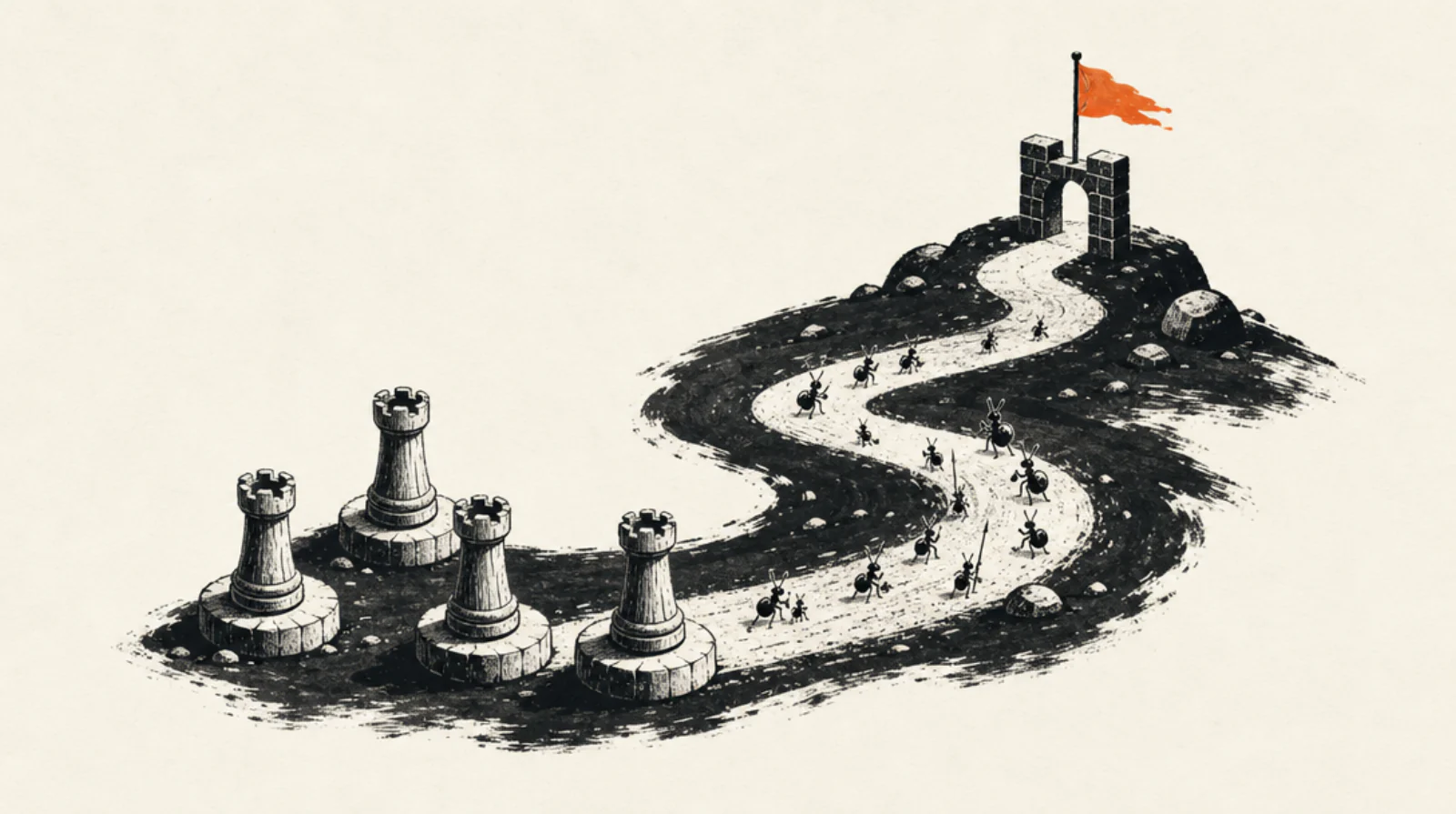
The brief below gives you a complete tower defense game on the first build: one winding path, twelve build pads, four towers that each do a different job, fifteen waves with new enemies introduced one at a time, a gold economy with a bonus for calling waves early, and controls that work as well under a thumb as under a mouse. Copy it into a new Startbase project. After the first playthrough, the follow-ups move the map into the World Editor and add upgrades. For the design thinking behind it, see the tower defense guide.
Paste this prompt
Make a 2D tower defense game in a clean hand-drawn style seen from above, for desktop and phones (landscape). One map: enemies enter on the left and follow a single winding dirt path to a gate on the right. Along the path are 12 round stone build pads; towers can only be built on pads. The player starts with 150 gold and 20 lives; each enemy that reaches the gate costs 1 life (bosses cost 5). Towers: Archer (cost 50, single target, 1 shot per 0.8 s, range 3 tiles, can hit flying enemies); Cannon (cost 80, splash damage in a 1 tile radius, 1 shot per 2 s, range 2.5 tiles, cannot hit flyers); Frost (cost 70, slows every enemy in range by 40 percent for 1.5 s, no damage, range 2 tiles); Sniper (cost 120, very high single-target damage, 1 shot per 3 s, range 6 tiles, targets the strongest enemy in range). Every tower has two upgrades that cost 75 percent of its price each and raise damage or slow by about 40 percent. Selling refunds 70 percent of everything spent. Enemies: Runner (fast, low health), Grunt (medium speed and health), Shield (slow, high health, takes half damage from Archers), Bat (flying, fast, can only be targeted by Archer, Frost and Sniper), Ogre boss (wave 10 and 15). Wave table: waves 1 to 3 Grunts only; wave 4 introduces Runners; wave 6 introduces Shields; wave 8 introduces Bats; wave 10 is an Ogre with Grunts; waves 11 to 14 mix everything with rising counts; wave 15 is two Ogres with escorts. Enemies grant 5 to 30 gold when killed. Between waves the player can build freely; a Next wave button starts the next wave early and pays 1 gold per second skipped. A 2x speed toggle. Controls: tap or click a pad to open a ring menu of the four towers with prices, greyed out when unaffordable; tap a tower to see its range circle, upgrade and sell; tap empty ground to close menus. All buttons at least 48 px. Feel: towers recoil when they fire, enemies flash when hit and pop into coins on death, coins fly to the gold counter. Sound: a light march loop, distinct firing sounds per tower, a low horn when a wave starts, a thud when a life is lost. Screens: title, HUD (gold, lives, wave x of 15, next wave button, speed toggle), pause, victory and defeat screens with stars (3 stars at 20 lives left, 2 at 10 or more, 1 otherwise).
The reasoning behind the brief
Four roles, not four damage levels
A first build often produces four towers that are the same tower with bigger numbers. Then the right move is always to build the most expensive one. Here each tower answers a different problem: Archers handle Bats, Cannons handle crowds of Grunts, Frost makes everything else better, and the Sniper deals with Shields and Ogres. The Shield's half damage from Archers and the Bat's immunity to Cannons force the player to mix.
A wave table that teaches
One new enemy every two to four waves gives the player time to learn each threat before the next arrives. The table also gives the agent something to build exactly, and gives you something exact to change. The difficulty curve guide explains why rests between spikes matter.
An economy with a decision in it
Building, upgrading and the early-wave bonus all compete for the same gold. The 70 percent refund lets players fix a bad placement without making selling a free rebuild. Calling waves early turns confidence into gold, which is the risk-reward choice confident players enjoy.
Pads and ring menus
Free placement with drag-and-drop is fiddly with a thumb and easy to misplace. Pads make every build target large, make the map balanceable and keep the path unblockable. The ring menu shows prices and affordability at the moment of choice.
Three follow-ups after the first build
- 01Move the map into the World Editor. Make the path, the build pads, the gate and the scenery parts of the level scene, so I can drag pads and bend the path in the World Editor and enemies follow the new path automatically.
- 02Show the waves coming. Before each wave, show a small preview strip of the enemy icons and counts in the next wave, so players can build for it.
- 03Add a second map. Add a second map where the path splits in two and joins again before the gate, with enemies alternating between the branches. Unlock it after earning at least 1 star on the first map.
Once the map is a level, your hand edits in the World Editor cost no credits, so tuning pad positions is free. Play a wave, move a pad, play again.
Two variations
- Maze builder. Replace pads and the fixed path with an open grid: "Towers can be built on any empty tile; enemies always take the shortest path to the gate around towers; a tower cannot be placed if it would block every path." This is a different, deeper game, and pathfinding needs testing on every build.
- Hero defense. Keep the map and towers, and add a hero the player moves by tapping the path, who fights enemies in melee and has one ability on a 20 s cooldown. It adds action between waves and suits players who find pure building too passive.
What usually goes wrong
- One tower wins everything. Usually the Archer, because its cost-to-damage is too good. Say the goal, not just the fix: "By wave 8, a map with only Archers should lose at least 8 lives." Then tune numbers until that holds.
- Towers shoot at the wrong enemy. Ask for a targeting rule per tower: first in line (closest to the gate) for Archer and Cannon, strongest for Sniper, and a toggle on each tower to change it.
- Projectiles miss fast enemies. Ask for projectiles that home in, or for instant hits with a visual trail, rather than shots aimed at where the enemy was.
- Waves drag at 2x speed with lag. Ask the agent to pool enemies and projectiles and to keep the game ticking at a fixed step so 2x speed runs two steps per frame rather than bigger steps that skip collisions.
- The ring menu covers the pad on phones. Ask for the ring to open above the finger and to flip below when the pad is near the top edge.
Budget and publishing
Most of the cost in a tower defense build is balancing rounds, not the first build. Expect several short turns of numbers. What it costs to make a game compares this with hiring help. When all fifteen waves are winnable on 3 stars but not easily, publish it and share it to the Arcade.
Frequently asked questions
How many waves should a tower defense level have?
Ten to twenty waves per map is a common range for short sessions. Fifteen gives room to introduce four enemy types and two boss waves without the map dragging.
Why build pads instead of placing towers anywhere?
Pads give big, precise tap targets on phones, keep the path from being blocked and make the map easier to balance. Free placement is a good second game: the maze-builder variation shows how to ask for it.
Can I change the path after the first build?
Yes. The first follow-up moves the path and pads into the level so you can reshape them by hand in the World Editor, and enemies follow the new path.

