Bullet Patterns for Shoot 'em Ups
Every bullet hell pattern is built from a handful of primitives and four numbers. Here is the vocabulary, the values and the rules that keep it dodgeable.
Key takeaways
- Almost every pattern combines five primitives (aimed shot, fan, ring, spiral, wall with a gap) with four numbers: count, spread, speed and timing.
- Fairness is geometry: gaps at least three times the player hitbox, bullets slower than the player, and a tiny hitbox of 2 to 4 pixels radius in dense patterns.
- Write patterns as timelines of data so a boss phase is a list you can tune, and drive them by time, never by frame count.
A bullet pattern is a rule that spawns enemy projectiles in a shape: a ring, a fan aimed at the player, a spiral, a wall with a gap. Shoot 'em ups (shmups) and bullet hell games are built from a small set of these primitives combined and timed against each other. To build them, give each primitive four numbers (how many bullets, the angle they cover, how fast they fly, how often they fire), make the gaps large enough for the player's hitbox, and script patterns as data so you can tune a whole boss by editing a list.
The five primitives
- Aimed shot. One bullet toward the player's current position. The basic pressure tool: it forces the player to keep moving.
- Fan (spread). N bullets across an angle, centered on the player or a fixed direction. Five bullets over 60 degrees is a common start. Aimed fans punish staying still; fixed fans create lanes.
- Ring. N bullets evenly around 360 degrees, each `360 / N` degrees apart. Rings of 12 to 24 are typical. Dense rings force the player to slip through a gap.
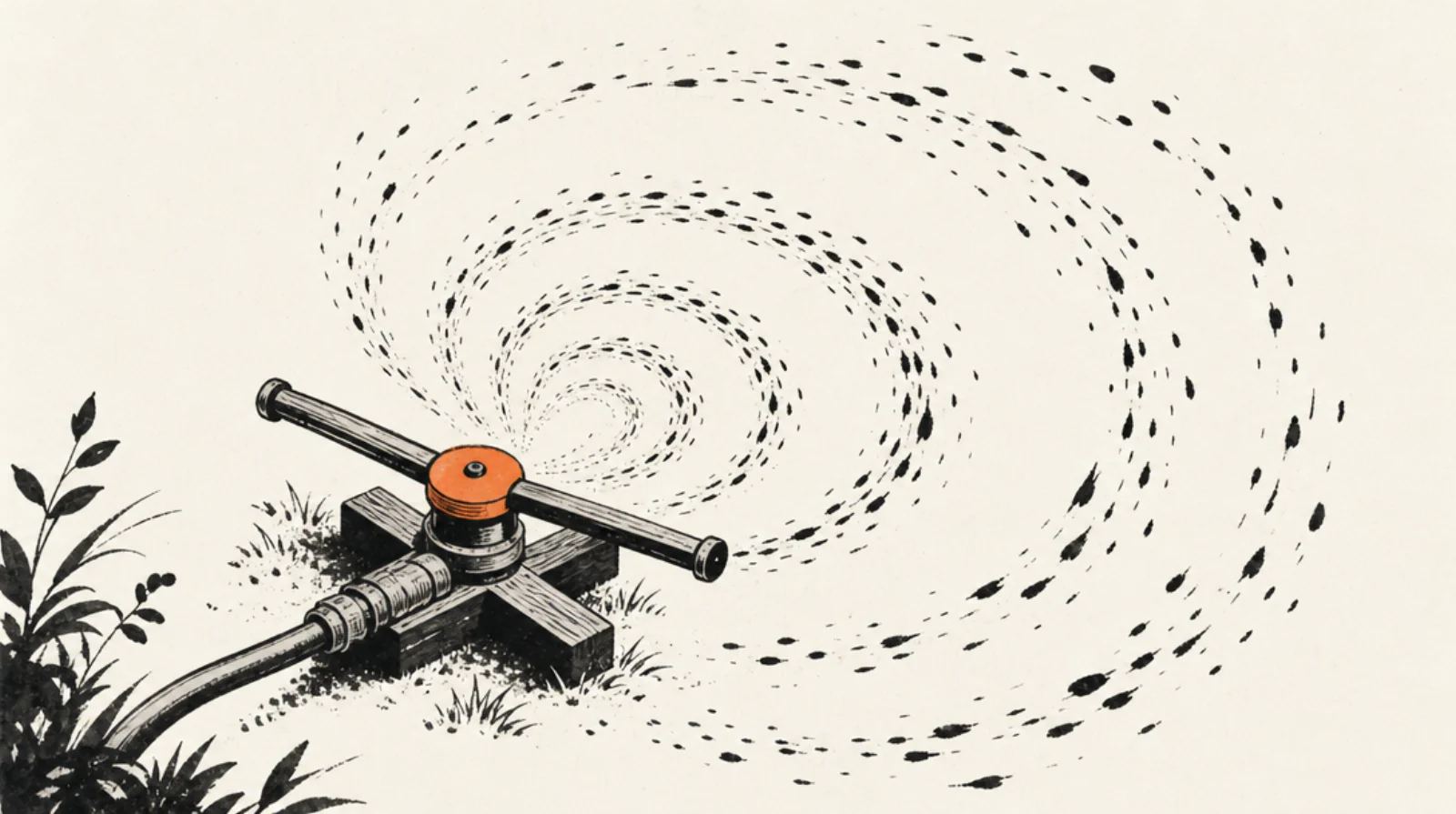
- Spiral. A ring or a single stream whose starting angle rotates every shot: `angle += step` with steps of 7 to 15 degrees. Two spirals turning in opposite directions create the classic woven pattern.
- Wall with a gap. A line of bullets across the screen with one or two openings. Readable and tense, especially when the gap moves.
Everything else is a variation: random sprays (aimed fans with jitter), streams (fast aimed shots in a burst), rings that pause and then re-aim at the player, bullets that split into smaller rings, and lasers, which are walls that warn before they fire.
The numbers behind a pattern
- Speed. Enemy bullets usually travel 100 to 250 pixels per second at 720p, slower than the player. Mixing two speeds in one pattern (a slow ring and a fast aimed shot) is a cheap way to add depth.
- Acceleration. Bullets that start slow and speed up (from 60 to 220 over a second) look graceful and give the player time to read the shape.
- Angular velocity. Bullets that curve as they fly (a few degrees per second of turn) turn simple rings into flowers. Use sparingly; curved paths are harder to predict.
- Fire interval. Rings every 0.5 to 1.5 seconds, spirals every 0.05 to 0.15 seconds, aimed shots every 0.8 to 2 seconds per shooter.
- Count and spread. Decide them together. A 90 degree fan of 10 bullets has 10 degree gaps; at 200 pixels distance that is about 35 pixels between bullets, which is dodgeable only with a very small hitbox.
- Lifetime. Bullets are removed when they leave the screen plus a margin (32 to 64 pixels), or after a maximum lifetime so curving bullets cannot orbit forever.
Fair patterns are geometry
Dense bullet hell feels fair when the player understands exactly where they can be. That comes down to a few rules:
- Tiny hitbox. In dense games the player's hurtbox is a circle of 2 to 4 pixels radius at the center of the ship, often drawn as a visible dot while focusing. Graze-heavy designs depend on it.
- Gaps at least three times the hitbox diameter at the point where the player has to pass. Measure at the distance the player will actually be, since ring gaps widen as bullets travel outward.
- Bullets slower than the player. Especially the player's slow, focused movement speed, which should still outrun the slowest bullets.
- Bullets are the brightest thing on screen, with an outline, drawn above enemies and effects. Player shots are dimmer. Our top-down shooter guide has the full readability checklist.
- Telegraph anything sudden. Lasers flash a thin line for 0.5 to 1 second before firing. Bullets never appear in the middle of the screen without a visible source.
- Do not spawn bullets on the player. Patterns fired from an enemy touching the player can be impossible to dodge. Skip bullets that would spawn within a small radius of the player.
Patterns as timelines
A boss phase is a list of pattern calls on a timeline. Writing it as data, instead of as nested timers in code, makes it readable and tunable:
- 010 s: ring of 16, speed 140, every 1.2 s, for 6 s.
- 022 s: aimed fan of 5 over 40 degrees, speed 200, every 2 s.
- 036 s: pause 1 s (the breath).
- 047 s: double spiral, 2 arms, step 11 degrees, every 0.08 s, for 5 s.
- 0512 s: loop.
Breaths matter. A pattern with no gaps in time feels like a wall; a one-second pause between attacks lets players reposition and appreciate the next shape. Our boss fight guide covers phases, and in a shmup each phase usually ends by turning every bullet on screen into score pickups, which gives a satisfying release and clears the screen for the next phase.
Bugs bullet patterns usually cause
- Frame-counted patterns. A spiral that adds 11 degrees per frame spins twice as fast at 120 Hz. Drive firing with accumulated time and fire as many shots as the elapsed time requires, at the angles they would have had.
- Aiming at a stale position. An aimed shot should read the player's position at the moment of firing, not when the pattern started. Leading shots that predict movement should be rare: they feel like cheating.
- Overlapping patterns create walls. Two fair patterns can add up to an impossible one. Test each combination at its densest moment, not just each pattern alone.
- Garbage collection stutters. Hundreds of bullets created and destroyed per second cause hitches on phones. Pool them: allocate 500 to 2,000 bullets up front and reuse them.
- Collision cost. Use circles for bullet collisions and only test bullets against the player (and player shots against enemies), not bullets against each other. See smooth games on phones.
- Bullets surviving a death. Clear or fade enemy bullets when the player respawns, or the player can die again on arrival.
How patterns combine with other mechanics
Grazing rewards passing close to bullets with score or meter, which turns the fairness geometry into a skill. Bombs clear the screen and give invincibility frames, the shmup safety valve, usually limited to two or three per life. Difficulty levels are easiest to build by scaling pattern parameters: fewer bullets per ring and slower speeds on easy. That is also a good accessibility option; our accessibility guide covers presenting it without shame. Enemy waves carry small patterns on many enemies, while bosses carry big patterns on one.
A brief to paste
A vertical shoot 'em up for phone and desktop, portrait. The player ship follows the finger with an offset so the thumb does not hide it; a second finger held anywhere slows it to half speed and shows the 3 px hitbox dot. Enemy bullets are bright pink circles with a dark outline, drawn above everything except the player. Build a pattern system from data: aimed shot, fan, ring, spiral and wall with a gap, each with count, spread, speed, acceleration, interval and lifetime. Patterns are driven by time, not frames. Bullets never spawn within 40 px of the player, and all bullets are pooled. Make one boss with three phases written as timelines with a 1 s breath between attacks; each phase ends by turning all bullets into score gems. Expose bullet speed scale and count scale as dials so I can make easy and hard versions.
Frequently asked questions
How do you make a spiral bullet pattern?
Fire bullets at a regular interval and rotate the firing angle a fixed step each time, often 7 to 15 degrees. Firing several arms at once, or two spirals rotating in opposite directions, makes richer patterns.
How big should the player hitbox be in a bullet hell game?
Much smaller than the ship sprite, typically a circle of 2 to 4 pixels radius at its center. Many games show it as a dot while the player is in focus mode.
How many bullets can a web game handle?
It depends on the device and the effects used. With pooled bullets, simple circle collisions and no heavy effects, several hundred on screen is usually manageable on modern phones. Measure on the phones you care about.

