How to make a game like Vampire Survivors
In a survivors-like, the player only steers and chooses. The game is the spawn director, the upgrade menu and how many enemies the phone can draw at once.
Key takeaways
- Movement is the only skill input; weapons fire on their own. All the depth comes from positioning and which upgrades you pick.
- A spawn director that schedules enemy types and density by minute is the real level design of the genre.
- Plan for hundreds of enemies from day one: pooling, a spatial grid for collisions and cheap sprites.
To make a game like Vampire Survivors, build a top-down arena where the player only moves, weapons attack automatically on timers, enemies stream in from just off screen in growing numbers, and every defeated enemy drops experience that fills a bar toward a level-up choice of new weapons or upgrades. Survive a fixed time to win the run, and spend what you earned on permanent upgrades before the next one. The genre is often called survivors-like or a horde survival roguelite. Its name and characters, art, music and stages belong to its owner, but the format itself has been picked up by many games, and it rewards new twists.
Why the horde formula hooks people
- Low input, high spectacle. One stick (or one thumb) to move. The screen fills with effects you earned through choices, which feels like power without demanding reflexes.
- A choice every 30 to 60 seconds. Level-up picks arrive often enough that players always have a plan for the next one.
- Weak to unstoppable in one run. The start is tense and fragile. By the end, the build carves through hundreds of enemies. That arc is the payoff.
- Short, complete runs with a meta layer that makes even a failed run count.
The five systems to build
1. Movement and the arena
Eight-direction or analog movement at a steady speed, no acceleration curve (or a very short one). The arena is either a large bounded field or an endless tiled ground that wraps around the player. A virtual joystick that appears wherever the thumb lands works better on phones than a fixed one. The top-down movement guide has the details.
2. Auto weapons
Each weapon is data: cooldown, damage, projectile count, area, pierce, speed and a targeting rule (nearest enemy, facing direction, random, orbit around the player, or an aura). Leveling a weapon changes those numbers. Give each weapon a distinct shape on screen so players can read their build at a glance: one that fires forward, one that circles, one that hits a zone, one that chains.
3. The spawn director
A timeline that says, for each minute of the run, which enemy types appear and how many should be alive at once. Enemies spawn on a ring just outside the visible screen, biased toward the direction the player is moving so they never run into empty space. Add scripted moments: a tight circle of enemies closing in, a fast swarm crossing the screen, an elite with a guaranteed chest. The enemy waves and spawners guide covers spawn rings and budgets in depth.
4. Experience and level-ups
Enemies drop gems that the player must walk near to collect (a pickup radius you can upgrade). Required experience per level rises gently: a starting point is level n needs about 5 + 10 × n points, adjusted so players reach roughly level 20 to 30 in a 15-minute run. On level-up, pause and offer three cards: new weapons, upgrades to owned weapons, or passive stats (speed, area, cooldown, pickup radius, health). Cap the number of weapon and passive slots (six of each is a common shape) so choices have a cost.
5. Combos and the meta layer
The genre’s best moment is discovering that two items combine. Design a few pairs where a maxed weapon plus a specific passive turns into a stronger form, and hint at them without spelling them out. Between runs, coins buy small permanent boosts and unlock new starting characters or weapons. See the upgrades and progression guide for pacing a meta layer so it helps without trivializing the run.
Numbers to start tuning from
- Run length: 10 to 15 minutes for a phone game. Long enough for a full power arc, short enough for a bus ride.
- Alive enemies: around 20 at minute one, 150 to 300 at the peak. Test the peak on a mid-range phone early.
- Player speed slightly faster than the basic enemy, slower than the fast type. The player must be able to escape, but not forever.
- Contact damage with a short invulnerability window (about half a second) after each hit, so a crowd does not delete the player in one frame. The knockback and invincibility frames guide explains the timing.
- Level-up cards: three choices, with one free reroll per run as a starting point.
Performance: hundreds on screen
A horde game lives or dies on frame rate. Build these in from the start, not when it starts stuttering:
- Object pools for enemies, projectiles, gems and damage numbers. Never create and destroy hundreds of objects per second.
- A spatial grid for collision: bucket enemies by cell and check projectiles only against nearby buckets, instead of every projectile against every enemy.
- Merge gems when too many are on the ground: combine distant ones into one bigger gem.
- Simple enemy brains: most enemies just move toward the player, with a light separation push so they do not stack into one sprite.
- Cap effects: limit simultaneous damage numbers and particles.
The game performance on phones guide covers draw calls and batching if you go further.
Three twists that make it yours
- 01A home base you defend. The player still moves freely, but a structure in the center loses health when enemies reach it. Suddenly positioning is about intercepting, not fleeing.
- 02Upgrades with drawbacks. Every level-up card has a cost (more damage but slower, bigger area but enemies move faster). Builds become a balancing act instead of a pile of buffs.
- 03Light as a resource. The arena is dark and the player’s radius of light shrinks over time; collecting experience restores it. Enemies are only visible inside the light, so greed and safety pull in opposite directions.
A brief for an original horde survival game
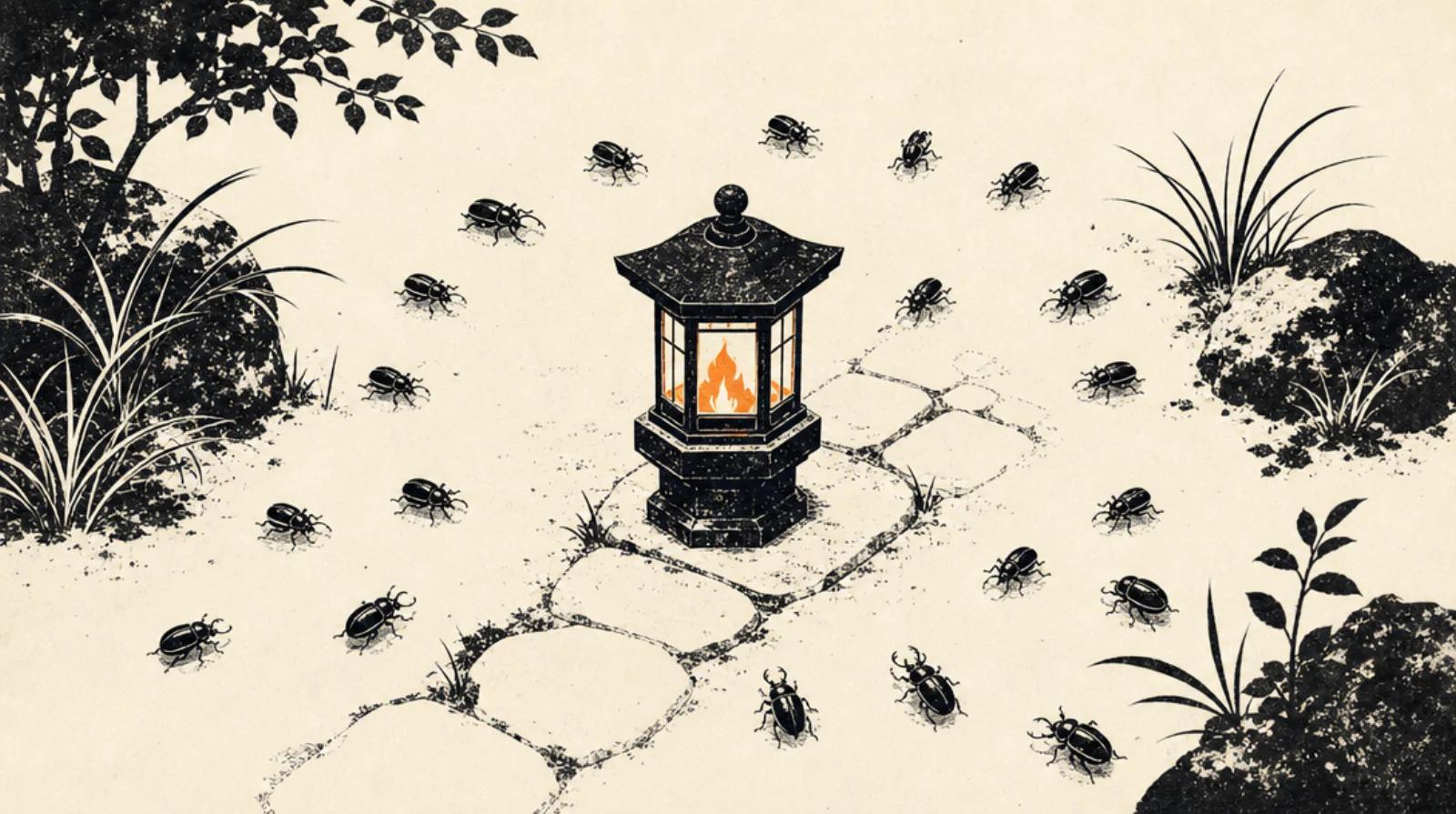
A top-down horde survival roguelite called Night Garden, for phones and desktop. The player is a gardener with a lantern in a walled greenhouse garden at night. Move with a floating thumb joystick or WASD; tools attack on their own: pruning shears that snip the nearest pest, a watering can that sprays a cone forward, seed pods that orbit, and a lantern aura that slowly burns anything close. Beetles, moths and slugs spawn on a ring just off screen, following a minute-by-minute schedule that peaks around 200 alive enemies at minute 12. Defeated pests drop dew drops; walking near collects them; leveling offers three cards (new tool, tool upgrade, or passive like speed or pickup radius), max five tools and five passives, one reroll per run. Twist: the lantern’s light radius shrinks every second and dew restores it; pests outside the light are only silhouettes. Win by surviving 15 minutes and lighting the dawn. Coins buy small permanent upgrades between runs. Use object pooling and a spatial grid so 200 enemies stay smooth on a phone.
For another original angle on the same loop, the zombie survival prompt starts from a different theme and mechanics.
Frequently asked questions
What genre is Vampire Survivors?
It is usually called a survivors-like, bullet heaven or horde survival roguelite: a top-down game where weapons fire automatically, the player only moves, and runs are built from level-up choices.
How many enemies can a browser game handle?
With pooling, a spatial grid for collisions and simple sprites, a few hundred moving enemies is a realistic target on recent phones. Test on a mid-range device early and set your peak count from what you measure.
How long should a survivors-like run be?
For phone and browser players, 10 to 15 minutes is a good starting point. It leaves room for the weak-to-powerful arc while fitting into a short session.
Can I use the same weapons and characters?
No. Characters, art, music, names and specific item designs belong to the original’s owner. Design your own weapons, enemies and theme; the general auto-attack format is shared by many games.

