Upgrade Systems and Progression
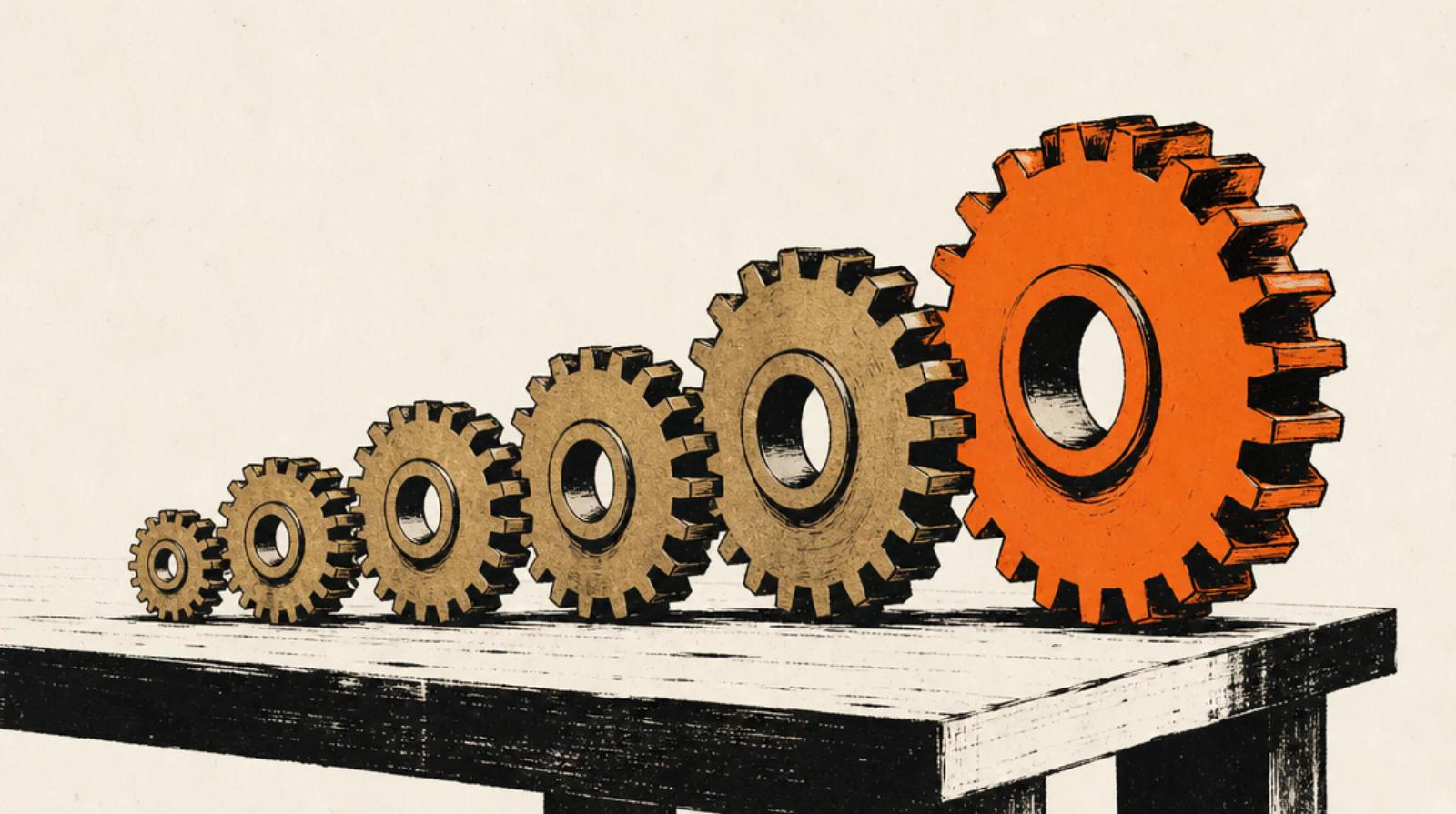
Upgrades are the promise that the next run will be a little better. The math behind them decides whether that promise lasts five hours or five minutes.
Key takeaways
- Pick the time between upgrades first (minutes early, longer later), then derive cost and XP curves from it.
- Add bonuses of the same kind together and multiply across kinds, and cap anything that is a percentage reduction.
- Player power and challenge must grow together, or upgrades either trivialize the game or feel like nothing.
An upgrade system lets players spend something they earned (coins, experience, materials) to make their character, tools or base permanently better, and progression is the curve that describes how fast that happens. To design one, choose how long players should wait between upgrades, set costs that rise with each level (a growth of 1.15 to 1.5 times per level is typical), decide how bonuses stack, cap the ones that can break the game, and make sure challenge grows alongside player power.
Kinds of upgrades
Upgrades differ in what they change and how long they last. Most games mix two or three of these:
- Stat upgrades: +10 percent damage, +1 heart, faster reload. Easy to build, easy to balance, and dull if they are all you have.
- New verbs: a dash, a second weapon slot, a magnet that pulls coins. These change how the game is played, and players remember them.
- Run upgrades: picked during a run and lost at its end, like roguelite boons. Big, swingy and fun because they are temporary.
- Meta upgrades: permanent, bought between runs. Small, steady, and the reason a failed run still felt worth it.
- Levels from experience: the RPG version, where defeating enemies fills a bar and each level grants points or stats.
A useful rule: for every three or four stat upgrades, offer one that adds a verb. A shop of ten "+5 percent" items is a spreadsheet; one with a double jump in the middle is a game.
Curves: cost, experience and time
Design the time between upgrades first, then turn it into numbers. A comfortable pacing for a small game:
- First upgrade in the first 2 to 5 minutes. Players should feel the system working before they lose interest.
- Then every 5 to 15 minutes through the middle of the game.
- Late upgrades every 20 to 40 minutes, and they should be the exciting ones, not more of the same.
For leveled upgrades, a geometric cost works: `cost(level) = base × growth^level`. For upgrades with only 5 to 10 levels, a growth of 1.3 to 1.5 keeps the last levels meaningful. For upgrades with dozens or hundreds of levels, as in idle games, growth sits lower, around 1.07 to 1.15; our idle clicker guide covers that case and bulk buying.
For experience levels, a common starting curve is `xpToNext(level) = 100 × level^1.5`. Going from level 1 to 2 takes 100, from 5 to 6 about 1,120, and from 10 to 11 about 3,160. Because enemies later in the game also give more experience, the time per level grows much slower than the numbers suggest. Measure it in play.
How bonuses stack
Most progression bugs are stacking bugs. Decide the rule early and write it down:
- 01Add bonuses of the same kind. Three "+20 percent damage" upgrades give +60 percent, not 1.2 × 1.2 × 1.2 (about +73 percent). Additive stacking grows linearly and stays predictable.
- 02Multiply across kinds. A +60 percent damage bonus and a separate "critical hits deal double" multiply. This is where builds get exciting.
- 03Apply in a fixed order. Base value, then flat additions (+5 damage), then percentage additions, then multipliers. If the order changes depending on which upgrade was bought first, players get different results from the same build.
- 04Cap reductions. Cooldown reduction, damage reduction and cost reduction must never reach 100 percent. A common approach is a hard cap (say 75 percent) or a diminishing formula like `reduction = 1 − 1 / (1 + 0.1 × points)`, which approaches but never reaches 100.
Power and challenge grow together
If player power rises and the game stays the same, upgrades trivialize it: the last third becomes a walk. If challenge rises faster than power, upgrades feel like nothing and the game feels like a treadmill. Keep a simple table: at each stage of the game, the expected player power (damage per second, health) and the enemy power (health, damage). Their ratio should drift slowly, with occasional moments where the player clearly outclasses old enemies. That moment of revisiting an early area and crushing it is one of the best feelings progression gives, so allow it deliberately.
The difficulty curve guide covers the challenge side: spikes, rests and flow. For a game where runs reset, keep meta upgrades modest (a full set making the game perhaps 30 to 50 percent easier), so skill stays the main thing that wins runs.
Bugs and edge cases
- Rebalancing breaks saves. You lower an upgrade's max level from 10 to 5; players at level 8 now have an impossible state. Clamp on load and refund the difference in currency.
- Floating point drift. Applying +10 percent a hundred times can leave a stat at 99.99999 when a check needs 100. Round displayed values, and compare with a tolerance or work in integers.
- Negative or zero values. A speed penalty stacked twice leaves the player unable to move. Clamp every final stat to a sane range.
- Respec without a cost check. Refunding points or coins twice when the respec button is tapped twice. Make respec one function that rebuilds from a clean state.
- Upgrades applied twice on load. The save stores both the upgrade levels and the final stats, and loading applies upgrades on top of the saved stats. Save levels only and always compute stats from them.
- Hidden numbers. Players cannot tell what an upgrade did. Show the before and after (fire rate 2.0 to 2.4 per second) on the upgrade card.
Combining upgrades with other systems
- With a shop: the shop is where meta upgrades are bought; price them from the earn rate, as in our shop and currency guide.
- With roguelite runs: run upgrades are drafted (pick one of three), meta upgrades are bought. Keep them visibly different.
- With abilities that gate the world: an upgrade that adds a verb can also open new places, which ties progression to exploration.
- With achievements: "Max out any upgrade" or "Win with no upgrades" are good targets that point at either end of the system.
A brief for an upgrade system
Add permanent upgrades to my top-down survival game, bought with scrap between runs. Six upgrades: max health, damage, move speed, pickup radius (stats, 5 levels each), plus a dash and a second weapon slot (one level each). Cost is base times 1.4 to the power of level; first upgrade affordable after one run. Bonuses of the same kind add, different kinds multiply, applied in the order base, flat, percent, multiplier. Cap move speed at plus 50 percent. Save only upgrade levels and compute stats from them on load. Each card shows the current and next value. Make base costs and growth Engine panel dials, and add a debug button that grants 10,000 scrap.
Then play a full game with the debug grant off and a stopwatch running. If the gap between upgrades in the middle of the game is longer than 15 minutes, lower the growth or raise the earn rate. The RPG guide shows how to write the stats and formulas down before balancing, which saves many rounds of tuning.
Frequently asked questions
What is a good cost curve for upgrades?
A geometric curve, cost = base × growth^level. For upgrades with 5 to 10 levels, growth of 1.3 to 1.5 works; for upgrades with many levels, as in idle games, growth of about 1.07 to 1.15.
Should upgrade bonuses add or multiply?
Add bonuses of the same kind and multiply across different kinds. Pure multiplication of everything grows too fast and is hard to balance.
How do I stop upgrades making the game too easy?
Track expected player power against enemy power at each stage, raise challenge alongside upgrades, cap percentage reductions below 100 percent, and keep permanent upgrades modest in games with runs.
What XP curve should an RPG use?
A common start is experience to next level = 100 × level^1.5, then adjust by playing. Later enemies give more experience, so the time per level grows slower than the numbers.

