Procedural Generation for Beginners
Good procedural generation is rules plus randomness, not randomness alone. Here is how seeds, room templates and validation turn dice rolls into levels worth playing.
Key takeaways
- Use a seeded random number generator so any level can be recreated from one number, for sharing, daily challenges and bug reports.
- Combine hand-made pieces with random arrangement: room templates and chunks give quality, randomness gives variety.
- Constrain and validate: every generated level must be completable, and rules should guarantee pacing, not just layout.
- Generate only what benefits from variety; hand-make the parts that need to teach or impress.
Procedural generation means the game builds content, like levels, maps or loot, from rules and random numbers instead of having every piece made by hand. For beginners, the most reliable approach is to combine hand-designed building blocks (rooms, chunks, enemy groups) with a seeded random generator that arranges them, and then check every result against rules that guarantee it is playable. Pure randomness produces noise; rules plus randomness produces variety that still feels designed.
When procedural generation is worth it
Generation is a tool for specific goals, not a shortcut to infinite content:
- Replayability: roguelikes and runners rely on each run being different, so mastery is about skill, not memorization.
- Endless modes: runners and survival modes need content that never runs out.
- Daily challenges: one seed per day, the same for everyone, gives a fresh puzzle with a fair comparison.
- Surprise in large spaces: scattering rocks, trees and grass over a landscape is tedious by hand and looks more natural with controlled randomness.
It is the wrong tool for tutorials, story beats, boss arenas and any level that has to teach a specific idea. Those need the intent described in our level design basics. Many successful games mix both: hand-made first levels and bosses, generated runs in between.
Seeds: randomness you can repeat
A computer's random function gives different numbers every time. A seeded random number generator gives the same sequence for the same seed. Generate the level using only that generator, and the seed (one number or a short string) fully describes the level.
- Sharing: "try seed 48213" lets players share a great run.
- Daily challenges: derive the seed from the date, so every player gets the same level today.
- Debugging: when a player reports an impossible level, the seed lets you recreate it exactly.
- Separate streams: use different generators (or seeds derived from the main seed) for level layout, loot and enemy behavior, so changing loot rules does not change every level layout.
Small, well-known seeded generators like mulberry32 or a simple xorshift are plenty for games; they are a few lines long, fast, and give identical results in every browser.
Room templates and chunks
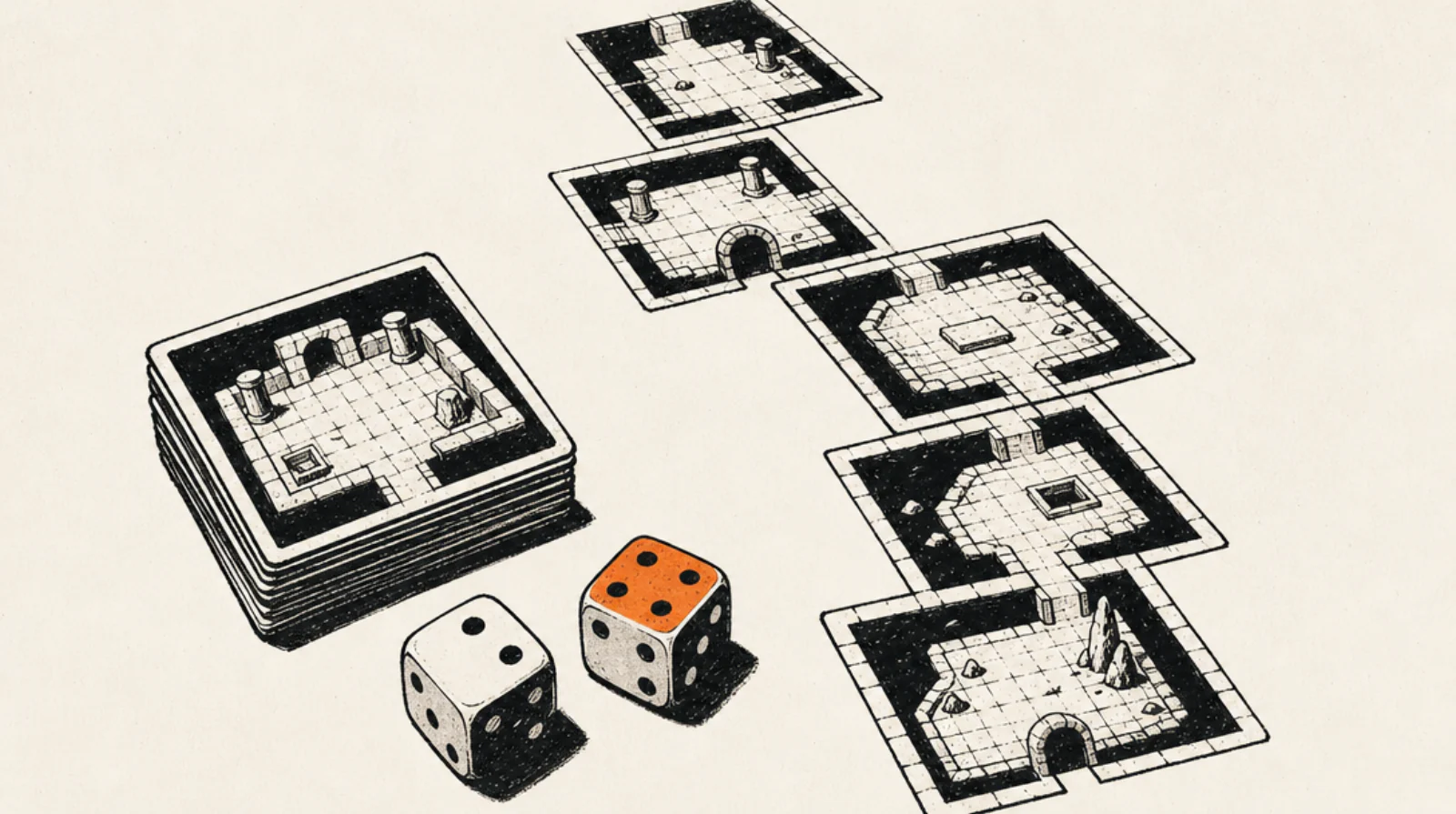
The most beginner-friendly technique is to author pieces by hand and let the generator arrange them. A famous cave-exploring roguelike builds each level as a grid of rooms, first carving a guaranteed path from the top entrance to the bottom exit, then filling each cell with a hand-made room template that matches the openings needed, with random variations inside the template. The result always has a solution path, but feels different every time.
A simple version for your game:
- 01Design 20 to 50 room or chunk templates by hand, each tagged with its exits (left, right, up, down), difficulty and type (combat, treasure, rest, shop).
- 02Generate a path through a grid: start at the entrance, step randomly left, right or down until you reach the bottom row.
- 03For every cell on the path, pick a template whose exits match the path. Fill cells off the path with any template, or leave them solid.
- 04Inside each template, randomize details: which enemy spawns, whether a crate holds a coin, which of two platforms appears.
- 05Place special rooms by rule: the exit at the end of the path, a shop roughly halfway, a treasure room off the main path.
Endless runners use the same idea in one dimension: a library of hand-made chunks (a gap, a low ceiling, a coin arc) appended one after another, chosen by difficulty as the speed rises. Dungeon crawlers often use a related approach: place rooms randomly, connect them with corridors, and make sure every room is reachable. The roguelike guide and the endless runner guide build on exactly this.
Rules and validation
Randomness will eventually produce something broken: a key behind its own locked door, an unreachable exit, five hard rooms in a row. Protect against it in two ways:
- Constraints during generation: never place two hard chunks in a row; always place a rest room after a combat room; the key always spawns on the path before the door.
- Validation after generation: run a check (for example, a pathfinding search from start to exit) and regenerate with the next seed if it fails. Cheap and robust.
- Pacing rules: generation should follow a difficulty budget per section, so a level has the tension and rest of a hand-made one. Our difficulty curve guide covers the shape to aim for.
Noise for terrain and scatter
For natural landscapes, designers use smooth noise functions (Perlin noise, simplex noise and their relatives) instead of plain random numbers. Noise gives values that change gradually across space, so neighboring points are similar: perfect for hills, islands, caves and biome boundaries. Layer a few noise "octaves" at different scales for detail, and use thresholds to turn values into terrain types (water below 0.3, sand to 0.35, grass to 0.7, rock above).
For scattering objects, pure randomness clumps unnaturally. Use minimum distances between objects (often called Poisson disk sampling) or jitter positions on a grid. In Startbase's World Editor, you can draw an area on the ground and ask the agent to "Scatter rocks here"; the agent changes only that area and leaves everything else where you put it, which is a handy mix of hand placement and generated detail. The survival game guide shows resource placement that creates travel decisions.
A brief for a generated dungeon
Add procedural floors to my roguelike. Use a seeded generator (mulberry32) for layout and a separate one for loot, never the built-in random. Each floor is a 4 by 4 grid: carve a path from a top-row start to a bottom-row exit, fill path cells with hand-made room templates that match the needed exits (I want 24 templates tagged combat, treasure or rest), and leave other cells solid. Rules: never two combat rooms in a row on the path, one rest room per floor, a treasure room off the path, difficulty rises by floor. Validate each floor with a path search and regenerate with seed + 1 if it fails. Show the seed on the pause screen and add a daily run seeded from the date.
Common procedural generation mistakes
- Randomness without structure, producing levels that feel like noise.
- No validation, so one level in a hundred is impossible, and players remember that one.
- Too few templates, so players recognize rooms after a few runs. Add templates over time and randomize their details.
- Generating what should be authored, like the first level and boss fights.
- Unseeded generation, making bugs impossible to reproduce.
Procedural generation is also why so many players like games with daily seeds and shareable runs. When your generator is ready, publishing a game with a daily seed and sharing it in the Arcade is a natural next step, and our leaderboards guide covers ranking players on the same seed.
Frequently asked questions
What is a seed in procedural generation?
A number or string that initializes a random number generator. The same seed always produces the same sequence, so the same level can be recreated for sharing, daily challenges or debugging.
What is the easiest way to start with procedural generation?
Author a set of rooms or chunks by hand and let a seeded generator arrange them along a guaranteed path. It produces variety while keeping each piece designed, and it is easy to validate.
How do I make sure generated levels are always beatable?
Build constraints into generation, such as always carving a path from start to exit first, then run a check like a pathfinding search after generation and regenerate with a new seed if it fails.