A Prompt for a Pinball Table
A complete pinball brief with the table layout, the scoring rules and the physics settings that make flippers feel right, then what to ask next.
Key takeaways
- Describe the table as a list of parts with positions, then the rules that connect them. Pinball is a layout plus a rule sheet.
- Ask for a fixed physics step and continuous collision for the ball in the first build, or the ball will pass through flippers.
- One mode, one multiball and a ball save are enough for a first table. Ramps and missions come in follow-ups.
A pinball prompt that works describes the table like a layout drawing (which parts go where), then the rule sheet (what hitting each part does), then the feel (physics values and controls). Pinball fails on feel more than on features, so the brief below spends as many words on flipper strength and ball speed as on the theme. It builds a portrait 2D table that fits a phone screen and plays on desktop with the keyboard.
The table brief
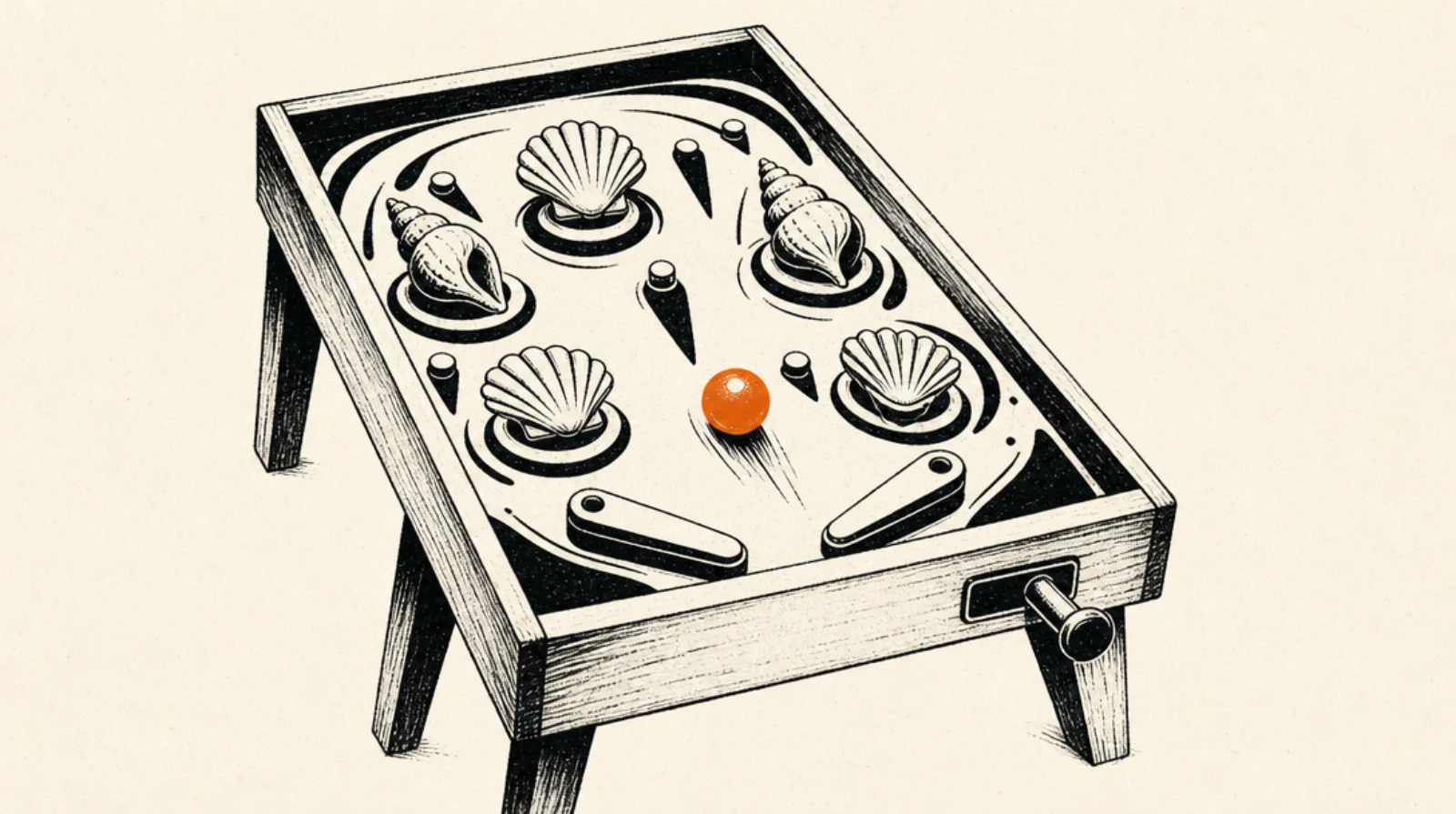
Build a 2D pinball table for the browser called Deep Dive, portrait, sized to fill a phone screen and centered on desktop. Layout from bottom to top: two flippers at the bottom with a gap slightly narrower than two balls; slingshots (angled kickers) above each flipper; outlanes on both sides with a kickback in the left outlane that is lit at the start of each ball; a plunger lane on the right. In the middle: three pop bumpers shaped like shells in a triangle, a bank of three drop targets on the left wall, and a spinner in the right orbit lane. At the top: three rollover lanes marked D, I, V. Rules: pop bumpers 100 points, slingshots 10, spinner 50 per spin, rollover lanes 500; lighting all three lanes raises the bonus multiplier by one (up to 5x) and the flippers rotate which lanes are lit; dropping all three targets scores 5,000 and resets them, and doing it twice in one ball starts a two-ball multiball for 30 seconds with doubled scoring. Three balls per game, a 10 second ball save at the start of each ball, an end-of-ball bonus count. Controls: left and right halves of the screen for the flippers, swipe down on the plunger lane or hold and release space to launch; keyboard Z and / for flippers; Shift nudges the table, and three nudges within five seconds tilts and ends the ball. Physics: a fixed 120 steps per second, continuous collision for the ball so it never passes through flippers or thin walls, gravity tuned so a ball takes about 1.5 seconds to roll from top to flippers, flippers that reach full swing in about 50 milliseconds. Feel: small screen shake on bumper hits, lights that flash on every hit, a score that counts up. Look: deep-sea theme, dark blue playfield with glowing coral, brass trim. Sound: bubbly bumper pops, a mechanical flipper clack, a sonar ping for drop targets, an underwater music loop. High score table of the top 10 with three-letter initials, saved in the browser. First version: this table only.
Why each part is there
- Layout bottom to top with relative sizes. "A gap slightly narrower than two balls" decides how often the ball drains down the middle. A table with a wide center gap is unplayable, and the agent cannot know that without being told.
- A kickback lit at the start. Outlane drains feel unfair. One rescue per ball is a classic way to soften them without removing the tension.
- Rules that link parts. Lanes raise a multiplier, targets lead to multiball. Without links, pinball is just bouncing; with them, players aim.
- Ball save. A ball lost in the first seconds is the most frustrating moment in pinball. Ten seconds of protection fixes it.
- Fixed physics step and continuous collision. Pinball balls move fast and flippers are thin. A variable step tied to frame rate lets the ball skip through a flipper between frames; this one sentence prevents the most common pinball bug.
- Timings in plain numbers. "1.5 seconds top to bottom" and "50 milliseconds swing" give the agent targets it can measure, instead of tuning by guesswork.
- Tilt. Nudging is part of real pinball skill. Tilt keeps it from becoming a way to never lose the ball.
The round-one guide on how to make a pinball game explains table design and physics in more depth, and game feel and juice covers the shake, flash and count-up effects that make every hit satisfying.
The first three follow-up prompts
- 01"Add the physics values as dials in the engine panel: gravity, flipper strength, flipper return speed, bumper kick, slingshot kick and ball bounce. I want to tune them while the game runs and keep what feels best."
- 02"Add a ramp from the right flipper that curves over the top and feeds back to the left flipper. A ramp shot scores 2,000 and counts toward a ramp combo: each ramp within 5 seconds of the last adds 1,000. Make the ramp visibly raised with a shadow."
- 03"Add a simple mission: after multiball ends, light a Treasure shot on the spinner lane for 20 seconds; hitting it scores 25,000 and plays a short treasure chest animation in the center of the table."
Two variations
A 3D table
Ask for the same layout and rules in 3D: "Build it in 3D with physics, a camera looking down the table from above the flippers at about 45 degrees, real shadows under the ball and light from the bumpers." 3D tables look spectacular but need more tuning, so start from a 2D version that already plays well and keep its numbers.
A one-screen mini table
For a quick arcade game, shrink it: "A tiny table with two flippers, one bumper and one target. One ball only, the score doubles every 30 seconds the ball survives." It is the right size for a game jam or a phone game people play in a queue.
What usually goes wrong and how to ask for the fix
- The ball goes through a flipper. Continuous collision is missing or the step is too large. Ask: "At full speed the ball sometimes passes through the left flipper. Use continuous collision for the ball, keep the physics at a fixed 120 steps per second regardless of frame rate, and limit the ball's top speed."
- Flippers feel weak or floaty. Ask: "The flippers cannot get the ball to the top lanes. Make the flipper swing faster and stronger, and make a ball hit near the flipper tip go higher than one hit near the base."
- The ball gets stuck. It rests on a slingshot or between a bumper and a wall. Ask: "If the ball has moved less than 5 pixels in 3 seconds and is not held on a flipper, give it a small random kick and log where it got stuck so we can fix that spot."
- Touch controls press both flippers. Ask: "On phones each half of the screen controls only its own flipper, and holding both at once must work. Ignore touches that start in the top third of the screen."
- The game runs faster on a 120 Hz screen. Physics follows the frame rate. Ask: "On a 120 Hz phone the ball is twice as fast. Decouple physics from rendering with a fixed time step and interpolate drawing."
Finishing touches before you publish
Play twenty balls and note how each one drained: center, left outlane or right outlane. A healthy table drains in all three places. If one dominates, adjust that area before adding features. Then publish and share the link; published games on Startbase can be added to a phone's home screen and play without page zoom, which suits pinball's quick sessions.
Frequently asked questions
What physics settings make pinball feel right?
A fixed, high physics rate (100 steps per second or more), continuous collision for the ball, fast flipper swings and gravity tuned so the ball crosses the table in one to two seconds. Then tune by playing.
Can a pinball game work with touch controls?
Yes. Split the screen into left and right halves for the flippers, allow both to be held at once, and use a swipe or hold for the plunger.
Should a first pinball table be 2D or 3D?
2D. It is easier to tune and to read on a phone. Once the rules and feel are right, a 3D version can reuse the same layout and numbers.