How to make a game like Space Invaders
The fixed shooter is one of the oldest designs in games and still one of the tightest. Here is the formation logic, the pacing tricks and the twists that make one yours.
Key takeaways
- The formation moves as one block: sideways until an edge, then one step down and reverse. Speed rises as the formation thins, which is where the tension comes from.
- Limit the player to one or two shots on screen. That single constraint turns shooting into aiming.
- Your game needs its own enemies, ship and look; the original's name, sprites and sounds belong to its owner.
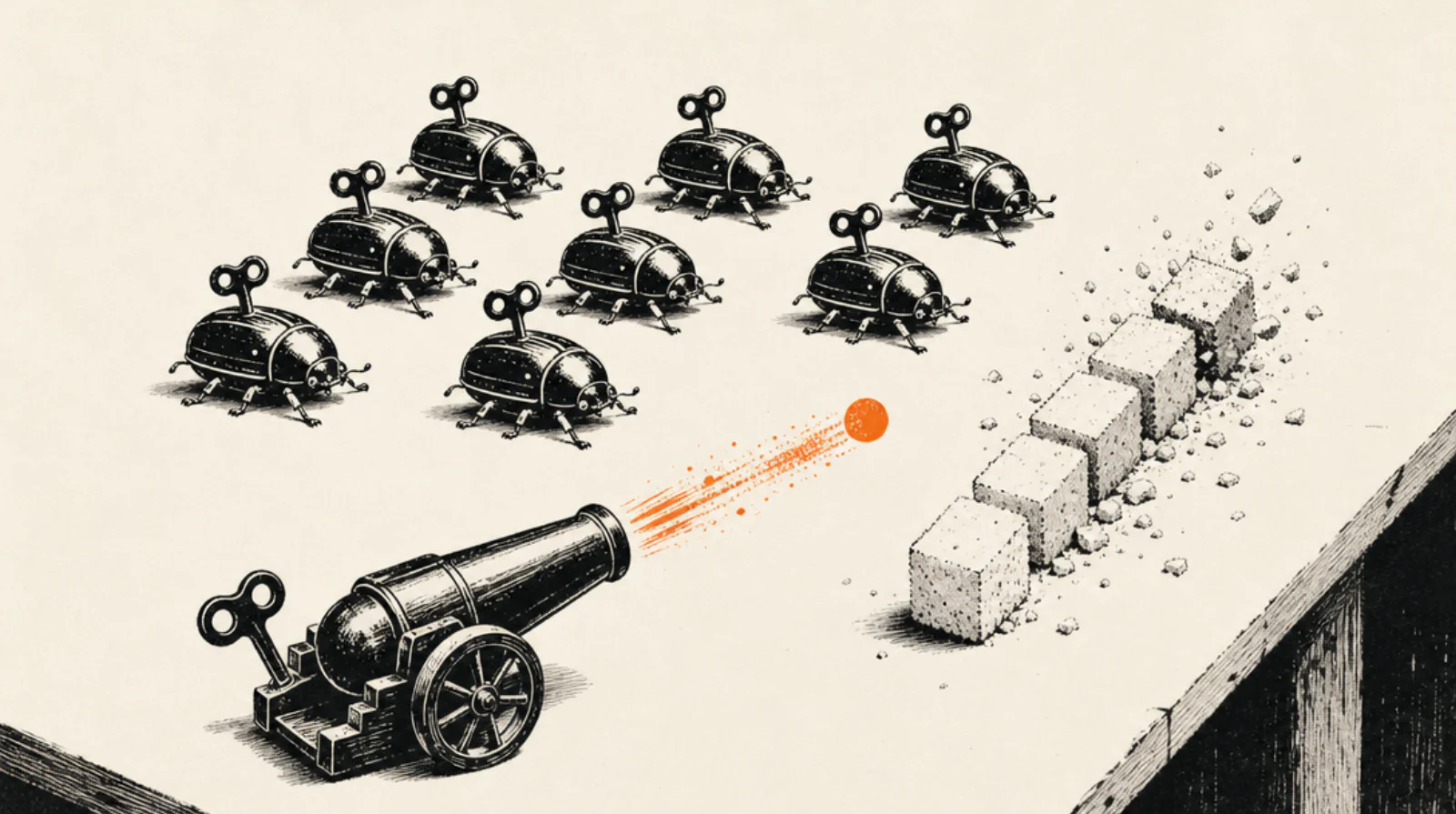
A game like Space Invaders is a fixed shooter: the player moves a cannon along the bottom of the screen and fires upward at a formation of enemies that marches side to side, drops a row each time it reaches an edge, and shoots back. Destroy every enemy to clear the wave; let the formation reach the bottom and the game ends. Build the formation, the one-shot firing rule and a speed-up as enemies die, and you already have the heart of the genre.
The name Space Invaders, its alien sprites, its sounds and its exact layout belong to its owner. What you can take is the design idea of a marching formation, which countless games have built on. Give yours its own enemies, its own ship and a reason to exist.
Why a marching formation is tense
The genius of the formation is that the player's progress makes the game harder. Every enemy you destroy leaves fewer to move, so the formation speeds up. The last few enemies race across the screen. That creates a natural crescendo in every wave without a single scripted event. Pair it with a slow, ominous march sound whose tempo follows the speed, and the player feels the pressure in their chest.
- One axis for the player. Left, right, fire. Anyone understands it in seconds.
- Threat is visible and creeping. The formation's height is a clock you can see.
- Cover decays. Shields absorb shots from both sides and wear away, so hiding is a resource you spend.
- Risk for reward. A bonus ship crossing the top is worth chasing, but chasing it leaves you exposed.
Formation logic, step by step
Store the enemies as a grid, for example 5 rows by 11 columns, each cell `{ row, col, alive, type, points }`, plus one formation offset `{ x, y, direction }`. Enemies are drawn at their grid position plus the offset. This keeps movement trivial and collisions cheap.
- 01Step, do not glide. Move the formation in discrete steps (2 to 4 pixels at a 320-pixel design width, scaled up), on a timer. A stepping march reads as mechanical and menacing; smooth sliding feels soft.
- 02Edge check uses live columns only. Find the leftmost and rightmost columns that still have a living enemy. When the next step would push either past the margin, drop the formation one row height (or half) and reverse direction.
- 03Tie the step interval to the count. A simple rule: interval = minInterval + (startInterval − minInterval) × (alive ÷ total). Start around 0.8 seconds per step and floor at about 0.05.
- 04Shooters are the bottom enemy of each column. Pick a random column with a living enemy and let its lowest member fire, so shots never pass through friends.
- 05Lose condition: the lowest living row reaches the player's height, or the player runs out of lives.
Shooting rules that create skill
The most important rule in the genre is the shot limit: one player shot on screen at a time (two at most). If the player can spray bullets, aiming stops mattering and it becomes a different game, the bullet hell, which has its own tools (see bullet patterns). With one shot, a miss costs time, and time is what the formation is spending.
- Player shot speed: fast, roughly a full screen height in 0.6 to 0.8 seconds.
- Enemy shots: slower, about half that speed, so the player can read and dodge them. Two or three enemy shot types (straight, wobbly, fast) add variety.
- Enemy fire rate rises with wave number, not with time inside a wave; the speed-up already handles the in-wave crescendo.
- Shots collide with shots. Letting the player cancel an incoming shot with their own rewards precision.
Erodible cover and the bonus target
Shields are where many clones cut corners. Real erosion means each shield is a small bitmap or grid of cells (for example 22 by 16), and a hit removes a ragged blob of cells around the impact point. Enemy shots chew from the top, player shots chew from the bottom, and enemies that march into a shield erase it. Store each shield as a 2D array of booleans and test bullets against cells, not a single rectangle. The destructible terrain guide uses the same idea on a larger scale.
The bonus target crosses the top of the screen every 20 to 30 seconds and is worth a variable score. It gives the player something to do besides grind the formation and creates the genre's favorite story: "I took the risk and got it."
Waves and progression
Each cleared wave restarts the formation one row lower than the last (capped, so it never starts on top of the player) with slightly faster base timing and fire rate. That is enough progression for an arcade score chase. For a longer game, introduce a new enemy type every few waves: one that takes two hits, one that dives out of formation, one that splits. The enemy waves and spawners article covers wave tables if you want them data-driven.
Three twists that make it yours
- 01The formation reacts. When you destroy a column, the enemies beside it close the gap, or the formation changes shape (a wedge, a ring). Now the player plans which column to break first.
- 02Cover you build. Instead of shields, the player has a few bricks they can place anywhere along the bottom between waves. Defense becomes a mini puzzle.
- 03Two cannons, one thumb each. Two cannons at the bottom, steered by the left and right thumbs, sharing one shot limit. It is great on phones and impossible to play on autopilot.
A brief to paste into Startbase
A 2D fixed shooter for phones and desktop, landscape. The player steers a small garden sprinkler along the bottom of a kitchen garden and fires single drops of water upward; only one drop can be on screen at a time. Above, a grid of beetles (5 rows by 10 columns, three beetle types worth 10, 20 and 40 points) marches sideways in discrete steps, drops one row when its outermost living beetle reaches the edge, and reverses. The step interval shrinks as beetles are destroyed, from 0.8 seconds down to 0.05. The lowest beetle in a random column fires seeds downward. Four lettuce heads act as cover, built from small cells that get eaten away where hit, from either side. Every 25 seconds a dragonfly crosses the top for a bonus. Three lives. Clearing a wave starts the next one a row lower and slightly faster. On phones: drag anywhere to steer, tap to fire. A marching sound whose tempo follows the step interval. Score and best score saved on the device. Expose step interval, shot speed and enemy fire rate as dials.
Publish it with one click once it plays well, and list it in the Arcade. If you want to go further toward screens full of shots and patterns, read the top-down shooter guide, or start from the bullet hell prompt.
Where fixed shooters go wrong
- Edge checks on the full grid. If you test the original grid width instead of living columns, the formation turns around too early once a side column is cleared.
- Unlimited fire. It deletes the skill. Keep the shot limit.
- Smooth movement. It looks expensive and plays dull. Step the formation.
- Rectangle shields. They feel fake. Use cells so damage is local.
- Touch fire that needs a button. On phones, tap anywhere to fire while dragging to move is easier than a tiny on-screen button.
Frequently asked questions
Why does the formation speed up as enemies die?
Because the step timer is tied to how many enemies are alive. Fewer enemies means shorter intervals, which builds tension toward the end of every wave without any scripting.
Is it legal to make a Space Invaders style game?
The genre idea of a marching formation is not owned, but the name, alien designs, sounds and exact presentation of the original are. Make your own enemies, art and title. This is general guidance, not legal advice.
How do I make shields that erode?
Represent each shield as a small grid of cells and remove a cluster of cells around each impact. Test bullets against individual cells instead of the whole shield rectangle.
Can a fixed shooter work on a phone?
Yes. Drag anywhere to move and tap to fire works well, and landscape or portrait both suit the genre. Startbase builds games as web games, so players open them from a link without installing.

