How to make a game like Subway Surfers
A lane runner is a swipe recognizer, three tracks of hand-built segments and a camera that keeps up. Get the lane change to feel instant and the rest follows.
Key takeaways
- Lane changes should finish in about a tenth of a second and accept a new swipe before they finish.
- Build the world from hand-made segments with multiple height levels, so players choose routes, not just dodge.
- A side hit is a stumble, not a death: two-strike rules keep runs going and make near misses dramatic.
Subway Surfers popularized the 3D lane runner on phones: a character runs forward automatically along three lanes, the player swipes left or right to change lanes, up to jump and down to roll, dodging obstacles and collecting coins while a pursuer follows close behind. Power-ups, missions and unlockable characters give reasons to keep running. To make your own you need a swipe recognizer, a three-lane movement model with jump and roll, a segment spawner with multi-level routes, and a speed curve. Subway Surfers’ name, characters, art, music and its world belong to its owner. The lane runner format is shared by many games and invites a theme of your own.
Why lane runners work on phones
- Four gestures, instantly learnable, and they map to directions on the screen exactly.
- Three lanes is a perfect decision size. Always a choice, never too many.
- Height adds routes. Climbing onto a long obstacle and running along its top is a reward and a shortcut. Routes make each run feel like your own path.
- Speed builds tension slowly. Early runs are relaxed; long runs become a blur.
Swipes and lane movement
- Swipe detection: register a swipe when the finger moves about 30 to 50 pixels within roughly 250 milliseconds. Decide direction by the larger axis. Trigger on movement, not on release, so the response is immediate.
- Lane change: move the character to the next lane over about 0.1 to 0.15 seconds with an ease-out curve, plus a slight lean. A swipe during a change should start the next change from the current position, so fast double swipes work.
- Jump: a fixed arc that clears low barriers, lasting about 0.6 to 0.8 seconds at starting speed. Shorten the airtime a little as speed rises so jumps keep covering similar ground.
- Roll: shrinks the hitbox to about half height for 0.6 seconds. A down swipe in the air should cancel the jump and slam down into a roll: experienced players rely on it.
- Keyboard: arrow keys or WASD for desktop players.
The mobile touch controls guide covers swipe thresholds and why a whole-screen gesture beats on-screen buttons for this kind of game.
Hit rules: crash or stumble
Not every collision should end a run. A common, forgiving rule set:
- Front hit (running straight into an obstacle face): the run ends.
- Side hit (changing lanes into the side of something): the character bounces back to the original lane and stumbles. The pursuer closes in for a few seconds. A second stumble while it is close ends the run.
- Shield item: a consumable that absorbs one crash and gives a moment of invulnerability. It turns a crash into a close call.
Use separate hitboxes for the character’s body and feet, so landing on top of an obstacle is safe while running into its face is not. Obstacles come in readable types: low (jump), high (roll), full (change lanes) and rampable (run up onto the top).
Segments and routes
Generate the course from hand-built segments, roughly 40 to 80 meters long, each designed with all three lanes in mind. The endless runner guide explains chunk generation and difficulty tags; for a lane runner, add two extras:
- Height levels: ground, top of long obstacles, and sometimes a higher path reached by a ramp. Coins on top routes reward players who go up.
- Lane guarantees: at every point, at least one lane must be passable at the current speed. Check this automatically when a segment is authored, at top speed.
- Coin trails as guidance. Coins show the safe line and the jump arc. A trail that ends in a wall is a lie players remember.
Speed starts moderate, grows on a curve that flattens, and caps. Spawn segments a few ahead of the player and recycle passed ones.
The 3D details that bite
- Floating origin: after a few minutes running forward, positions get large and physics and rendering jitter. Every so often, shift the whole world back toward zero.
- Camera: behind and above, looking slightly down, following lane changes with a small lag and pulling back a little as speed rises.
- Fog or a curved horizon hides segments popping in at the far end.
- Draw call budget: reuse a few materials and combine static meshes per segment. The phone performance guide covers batching.
Power-ups, missions and the shop
Keep power-ups to three or four, each with a distinct silhouette and sound: a coin magnet, a jump boost, a score multiplier and a flight that lifts the player above obstacles for a few seconds while collecting a coin line. Upgrades in the shop extend their duration. Missions (collect 300 coins in one run, roll 20 times) give short-term goals, and completing a set raises a permanent score multiplier. The power-ups guide and the in-game shop guide cover pricing and duration curves.
Three twists that make it yours
- 01You are the chaser. The player chases a runaway target; clean dodges close the distance, stumbles widen it. Catching it ends a chapter. The same mechanics, but the story flips from escape to pursuit.
- 02Lanes that move. The lanes themselves shift: rafts that drift, conveyor belts, tracks that merge into two lanes and split into four. Players read the road as well as the obstacles.
- 03Day and night runs. At night, only obstacles near light sources are visible, and collectible lanterns light the path ahead for a while.
A brief for an original 3D lane runner
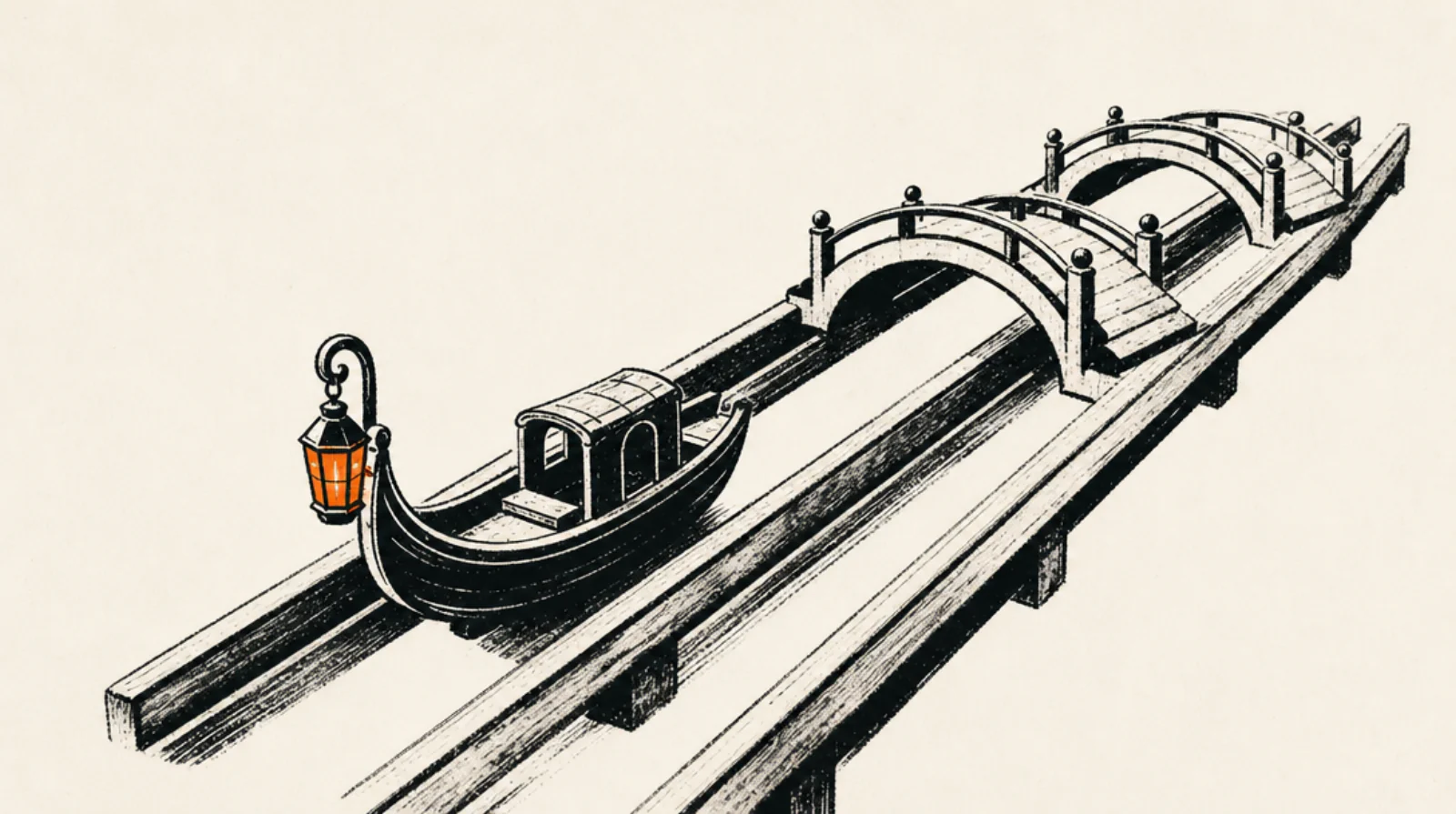
A 3D lane runner called Lantern Canal, portrait, phones first. A courier steers a small gondola through the canals of a lantern-lit water town at dusk, three channels wide. Swipe left or right to change channel (0.12 seconds, ease-out, swipes chain), swipe up to hop over low ropes and floating crates, swipe down to duck under low footbridges; a down swipe in the air drops straight into a duck. Long cargo barges can be ridden onto via ramps for an upper route with more coins. Front hits end the run; side hits bounce back and slow the gondola, and a second side hit within 6 seconds ends the run. Twist: the courier is chasing a runaway paper kite carrying a letter; clean dodges close the gap, slowdowns widen it, and catching it after about 90 seconds starts the next district with higher speed. Course from hand-built 60-meter segments tagged by difficulty, at least one passable channel always, coin trails showing the safe line. Speed rises on a capped curve. Power-ups: a coin magnet, a sail that lifts the gondola over everything for 6 seconds, and a double-score charm. Floating origin reset every 1,000 meters, soft fog at the far end, low-poly warm look.
For another original lane runner starting point, the phone endless runner prompt uses a different setting and rules.
Frequently asked questions
How do I make lane switching feel responsive?
Trigger the switch as soon as the swipe passes its threshold, finish the move in about 0.1 to 0.15 seconds, and allow a new swipe to start before the previous move finishes.
How do 3D runners avoid jitter on long runs?
They periodically shift the whole world back toward the origin (a floating origin), so positions never get large enough for precision problems.
Should a lane runner be 2D or 3D?
The three-lane format usually looks best in 3D with a behind-the-character camera. A 2D side-scroller is a simpler first runner if you want to learn chunk generation before tackling 3D.
Can I reuse the original characters or setting?
No. The characters, art, music and world belong to the original’s owner. Build your own setting, characters and a twist; the lane runner format itself is widely used.

